
Pick by the label: a complete protein such as whey, 20 to 40 g of it a scoop, little sugar and a fair price per gram of protein. That serving, carrying 0.7 to 3 g of leucine, is what the International Society of Sports Nutrition recommends for building muscle. In the trials whey beat plant protein only slightly, and not in all of them, so how much complete protein a scoop really holds matters more than whether it came from milk or peas.
“Protein powder” is typed into Google about 823,000 times a month in the US, more than three times as often as a year ago, and protein searches climb about 64% from December into January. Most of what comes back is a list of brands. Here instead are the six checks that turn any tub’s label into numbers you can compare, and what the research says about each.
The Short Version
- The serving: 20 to 40 g of a high-quality protein, carrying 0.7 to 3 g of leucine (International Society of Sports Nutrition position stand, 2017).
- Whey or plant: across 16 trials, protein source made no difference to gains in lean mass or strength overall, but animal protein came out ahead in adults under 50, by about 0.4 kg of lean mass (Nutrients, 2021).
- Isolate or concentrate: whey isolate is 90% protein or more, with much of the fat and lactose taken out (Journal of Sports Science and Medicine, 2004).
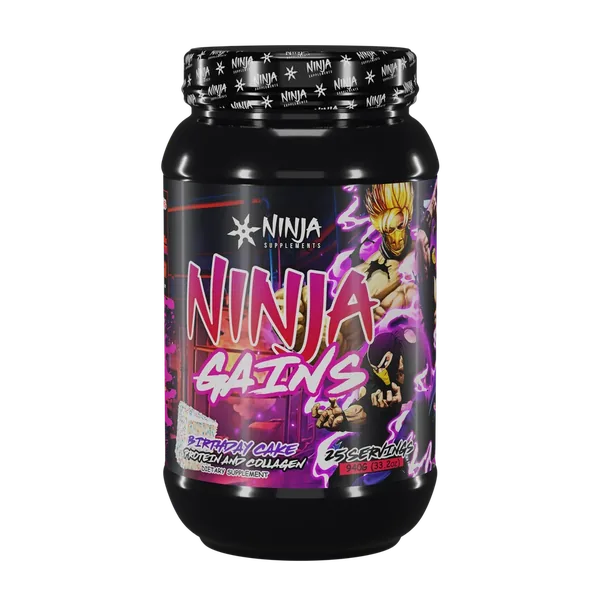
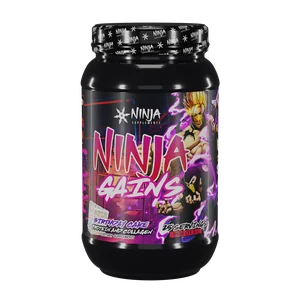
- Ninja Gains holds 31 to 33 g of protein a scoop depending on the flavour, 21 g of it complete protein from whey protein isolate, with about 2.1 g of leucine from the whey alone.
What Should You Look for in a Protein Powder?
Six things, and every one is printed on the tub or worked out from it. Turn the tub around: the back of the label tells you more than the front.
| The check | What to look for | Why it matters |
|---|---|---|
| Protein per scoop | 20 to 40 g | The serving the ISSN recommends for muscle building; about 0.25 g per kg of body weight |
| Where the protein comes from | A complete protein: whey, casein, milk, egg, soy, or a plant blend | Muscle building runs on the nine essential amino acids; collagen has no tryptophan |
| Leucine | 0.7 to 3 g a scoop, on the amino acid profile if the label prints one | The ISSN’s figure for a muscle-building serving |
| Sugar and calories | A few grams of sugar; most of the calories from protein | You are paying for protein, not a milkshake |
| Price per gram of protein | Price per scoop divided by grams of protein per scoop | Scoop sizes and tub counts differ; this is the fair comparison |
| Testing | A sport-testing seal if you are drug-tested in your sport | The FDA does not approve supplements before they are sold |
One trap on the protein line: it counts every protein in the scoop. On our own Ninja Gains it reads 31 to 33 g, and the ingredient rows show that 21 g of it is complete whey protein and 11 g is collagen. Collagen still counts toward your day (how many grams you need a day is in How Much Protein Do You Need a Day?), but it is not complete, so read the rows, not just the headline.
Is Whey Better Than Plant Protein?
A little, on some measures, and not in every trial. Whey digests fast and is rich in leucine and the essential amino acids, which is why it shines in the lab. In a 2009 study of young men, whey hydrolysate raised muscle protein synthesis after a leg workout about 31% more than soy isolate and about 122% more than casein, when each drink carried the same 10 g of essential amino acids. Six men per group, one session: a signal, not a verdict.
Over months, the gap shrinks:
- Whey ahead: in a trial of 63 untrained men and women through 96 supervised workouts over about nine months, the whey group gained 3.3 kg of lean mass, the soy group 1.8 kg and a carbohydrate group 2.3 kg, on similar calories (2013).
- A draw: a 2018 meta-analysis of nine studies and 266 people found soy produced similar gains in bench press, squat and lean mass to whey and other animal proteins.
- A lean, not a landslide: a 2021 meta-analysis of 16 trials found no difference in lean mass in kilos or in strength overall; animal protein came out ahead in percent lean mass, and in adults under 50 it added about 0.41 kg more lean mass.
- Pea held its own: in 161 young men taking 25 g twice a day for 12 weeks, biceps thickness and strength came out no different on pea protein and on whey (2015, partly run by a pea protein maker).
The reason plant protein needs more care is on the amino acid chart. A 2018 analysis found plant protein isolates such as oat, lupin and wheat were 21 to 22% essential amino acids, against 43% for whey, and most were lower in lysine and methionine. A 2015 review adds that most plant proteins run low in leucine and suggests eating more of them or mixing sources, and plant blends can come close to the animal profile (2018). So: if dairy sits well with you, whey is the efficient pick. If it does not, choose soy or a plant blend, take a bigger scoop, and check the leucine.
Whey Concentrate, Isolate or Hydrolysate: Which Should You Buy?
For building muscle, any of the three works; the differences are purity, lactose and how far the protein has been broken down. Whey isolate is 90% protein or more, with much of the fat and lactose removed in processing, which is why people who find dairy hard going often do better on it (Journal of Sports Science and Medicine, 2004). Concentrate keeps more of the milk’s fat and lactose. Hydrolysate is whey partly broken down before it goes in the tub, one of the fast proteins in the 2009 study above; we found no long-term trial showing it builds more muscle than isolate.
The practical order for most lifters: isolate if lactose bothers you or you want the most protein per calorie, concentrate if neither matters and it is cheaper per gram of protein.
How Much Protein and Leucine Should One Scoop Have?
20 to 40 g of protein a scoop, carrying 0.7 to 3 g of leucine. Those are the ISSN’s numbers for one muscle-building serving, or about 0.25 g of high-quality protein per kg of body weight: 20 g for an 80 kg lifter, 25 g for 100 kg. Under 20 g of complete protein is a snack; over 40 g is two servings in one scoop.
Leucine is the amino acid the ISSN singles out, so read its line on the amino acid profile if the label prints one. Whey makes it easy: on our own label, 23 g of whey protein isolate carries about 2.1 g of leucine.
Is Protein Powder Safe, and What About Heavy Metals?
For a healthy adult at normal servings, the best risk assessment we found says yes, but quality varies from tub to tub. After a magazine test of 15 powders, and another test that found elevated heavy metal levels in 40% of 133, a 2020 study ran a worst-case risk assessment on the reported levels of arsenic, cadmium, mercury and lead at one and three servings a day. None of the products posed an increased health risk. Mass gainer powders came closest to the line, and whey powders scored lowest.
What protects you is the label and the seller. The FDA does not approve dietary supplements before they are sold; the company is responsible for making sure what is in the tub is not adulterated or misbranded. If you are drug-tested in your sport, buy a product carrying a sport-testing seal such as NSF Certified for Sport, which screens for banned substances. If you are not, a full label with every ingredient and its amount is the minimum.
Coach’s Corner: The Session the Scoop Is For
- Dumbbell bench press: 3 x 8 to 10, 90 seconds rest. Shoulder blades pinned back, lower the dumbbells to your chest in two seconds.
- Lat pulldown or assisted pull-up: 3 x 8 to 12, 90 seconds rest. Pull to your upper chest, elbows driving down to your ribs.
- Dumbbell walking lunge: 3 x 10 steps a leg, 90 seconds rest. Torso tall, front knee over the ankle, back knee just above the floor.
- Seated dumbbell shoulder press: 3 x 8 to 10, 90 seconds rest. Ribs down, press up and slightly back until the dumbbells sit over your ears.
- Farmer’s carry: 4 x 30 to 40 metres, 60 seconds rest. Heavy dumbbells, shoulders down, short quick steps, no leaning.
Two or three times a week. The American College of Sports Medicine’s position stand puts muscle-building work mostly at 6 to 12 reps with 1 to 2 minutes of rest; when you can do one or two reps more than the target with clean form, add 2 to 10% to the weight. Healthy adults: if you have an injury, pain, a heart condition, or you are new to training, check with your doctor before you start. Stop if it hurts.
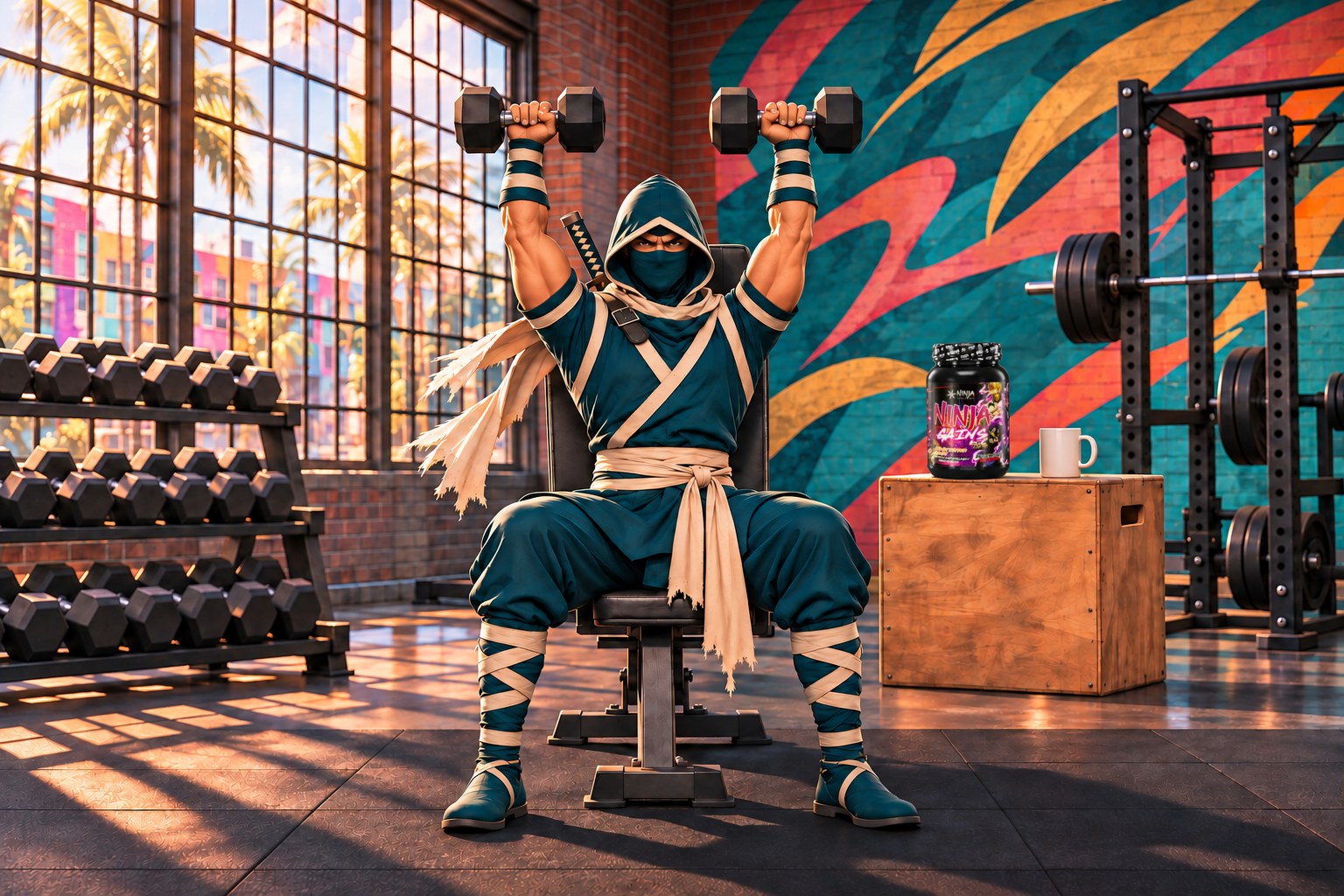
The Fuel Plan
| 80 kg (176 lb) lifter | 100 kg (220 lb) lifter | |
|---|---|---|
| Daily protein, 1.4 to 2.0 g per kg (ISSN) | 112 to 160 g | 140 to 200 g |
| One serving, 0.25 g per kg | 20 g | 25 g |
| Food first (USDA) | 150 g roasted chicken breast, 47 g; 3 hard-boiled eggs (150 g), 19 g; 170 g plain nonfat Greek yogurt, 17 g | |
| When the scoop goes in | After training or between meals, whichever gap food leaves; the ISSN finds before and after training both work | |
| The scoop in your macros (label) | Ninja Gains Salted Caramel: 130 calories, 31 g protein, 2 g carbs, 0 g sugar a scoop | |
These are general numbers for healthy adults. With kidney disease, diabetes or any medical diet, ask your doctor or a registered dietitian.
Where Ninja Gains Fits
Here is our own tub on the same six checks, because a buyer’s guide that skips its own product is a brochure. Ninja Gains: 31 to 33 g of protein a scoop depending on the flavour, inside the 20 to 40 g serving; 21 g of it complete protein from Provon 292 whey protein isolate; about 2.1 g of leucine from the whey alone, by the amino acid profile printed on the label, inside the ISSN’s 0.7 to 3 g. On top sits 11 g of hydrolyzed bovine collagen (types I and III): extra protein toward your day, not part of the muscle-building dose, and the label prints both sources with their amounts. 0 to 2 g of sugar and 130 to 157 calories a scoop, by flavour.
Straight talk on the sixth check: the Ninja Gains label carries no third-party sport-testing seal, so drug-tested athletes should buy a certified product. For everyone else, the label prints every active ingredient with its amount, plus the amino acid profile of both proteins. If you want a whey isolate scoop whose numbers you can check line by line, this is the tub.
Who it’s for: lifters who want a whey isolate scoop after training or between meals, and who like the collagen riding along. Who it’s not for: anyone avoiding dairy or soy (Peanut Butter Candy also contains peanuts), vegans, drug-tested athletes, and anyone after a meal replacement.
Ninja Gains: The Doses This Article Is About
Per serving, straight from the label. Protein per scoop: 32 g Birthday Cake, 31 g Salted Caramel, 33 g Peanut Butter Candy. The full label is on the product page.
| Provon®292 SFL (Instantized Whey Protein Isolate 90% delivering 21g of Complete Protein) (Cross-flow) microfiltration process. Instantized with Sunflower Lecithin) | 23000 mg |
| Hydrolized Bovine Collagen (Providing Type I and III Collagen) | 11000 mg |
The numbers: $57.99 for 25 scoops is $2.32 a scoop, or $1.97 with Subscribe and Save (15% off, $49.29 a tub). At 32 g of protein a scoop (Birthday Cake) that is about 7 cents a gram of protein, or 6 cents with Subscribe and Save. In stock today: Birthday Cake, Peanut Butter Candy and Salted Caramel.
Most often bought with it: Ninja Up, our high-stim pre-workout for experienced users, one scoop before the session and Ninja Gains after.
Best protein I've tried so far. I love the added collagen. Taste is incredible.
Best taste and macros of ALL proteins
Wow! Ninja Gains has absolutely everything I want in a protein now! 2G Grams of velositol! And the 11 grams of collagen! Why would anyone use any other protein?
Ninja Gains contains milk and soy, and Peanut Butter Candy also contains peanuts. If you take prescription medication, check with your doctor first.
Frequently Asked Questions
Is protein powder a dietary supplement?
Often, yes. In the US a product is a dietary supplement when its label says so, and many protein powders, Ninja Gains included, carry a Supplement Facts panel. The FDA does not approve dietary supplements before they are sold; the company that makes or sells one is responsible for making sure it is not adulterated or misbranded.
What is the cleanest protein powder?
There is no official “clean” standard, so judge what you can check: a short ingredient list, the protein per scoop and its source, the sugar, and any testing seal. In a 2020 risk assessment of published heavy metal results, whey powders scored lowest and none posed a health risk at one to three servings a day.
Why do some dietitians say no to protein powder?
Mostly because food can do the job. The ISSN agrees active people can get their protein from whole foods and calls powder a practical top-up, not a requirement. The rest is quality: sugar, fillers and testing vary from tub to tub.
Is whey isolate better than whey concentrate?
For building muscle the difference is small: both are complete proteins. Isolate is 90% protein or more with much of the fat and lactose removed, so it suits people who find dairy hard going.
Can you build muscle with collagen protein powder?
Not on collagen alone. Collagen is not a complete protein: it has no tryptophan, one of the nine essential amino acids. It still counts toward your daily protein, but the muscle-building dose should come from a complete protein such as whey.
Can you drink protein powder every day?
Yes, if you are a healthy adult and the scoop fits your daily protein. In a year-long study, 14 resistance-trained men eating about 2.5 to 3.3 g of protein per kg a day showed no harmful effects on blood fats, liver or kidney function. With a kidney condition, your doctor sets your number.
Next read: How Much Protein Do You Need a Day?, for the daily number this scoop is helping you hit. And for the session before the scoop: Do Nitric Oxide Boosters Work? When the day comes up short on protein, Ninja Gains is one scoop.
Sources
- Jäger R, et al. International Society of Sports Nutrition Position Stand: protein and exercise. Journal of the International Society of Sports Nutrition, 2017.
- Lim MT, et al. Animal Protein versus Plant Protein in Supporting Lean Mass and Muscle Strength: A Systematic Review and Meta-Analysis of Randomized Controlled Trials. Nutrients, 2021.
- Messina M, et al. No Difference Between the Effects of Supplementing With Soy Protein Versus Animal Protein on Gains in Muscle Mass and Strength in Response to Resistance Exercise. International Journal of Sport Nutrition and Exercise Metabolism, 2018.
- Volek JS, et al. Whey protein supplementation during resistance training augments lean body mass. Journal of the American College of Nutrition, 2013.
- Tang JE, et al. Ingestion of whey hydrolysate, casein, or soy protein isolate: effects on mixed muscle protein synthesis at rest and following resistance exercise in young men. Journal of Applied Physiology, 2009.
- Babault N, et al. Pea proteins oral supplementation promotes muscle thickness gains during resistance training: a double-blind, randomized, Placebo-controlled clinical trial vs. Whey protein. Journal of the International Society of Sports Nutrition, 2015 (three authors from a pea protein maker).
- Gorissen SHM, et al. Protein content and amino acid composition of commercially available plant-based protein isolates. Amino Acids, 2018 (two authors have received fees from dairy and nutrition companies).
- van Vliet S, Burd NA, van Loon LJ. The Skeletal Muscle Anabolic Response to Plant- versus Animal-Based Protein Consumption. Journal of Nutrition, 2015.
- Hoffman JR, Falvo MJ. Protein: Which is Best? Journal of Sports Science and Medicine, 2004.
- Bandara SB, Towle KM, Monnot AD. A human health risk assessment of heavy metal ingestion among consumers of protein powder supplements. Toxicology Reports, 2020.
- Paul C, Leser S, Oesser S. Significant Amounts of Functional Collagen Peptides Can Be Incorporated in the Diet While Maintaining Indispensable Amino Acid Balance. Nutrients, 2019 (one author from a collagen maker).
- Antonio J, et al. A High Protein Diet Has No Harmful Effects: A One-Year Crossover Study in Resistance-Trained Males. Journal of Nutrition and Metabolism, 2016.
- American College of Sports Medicine. American College of Sports Medicine position stand. Progression models in resistance training for healthy adults. Medicine and Science in Sports and Exercise, 2009.
- US Food and Drug Administration. Questions and Answers on Dietary Supplements. Read 3 November 2026.
- US Department of Agriculture. FoodData Central (SR Legacy: roasted chicken breast, hard-boiled egg, plain nonfat Greek yogurt), read 3 November 2026.
How we wrote this: we wrote this page because “protein powder” is searched about 823,000 times a month in the US and “best protein powder” another 74,000 (Google Ads Keyword Planner, September 2026), and the questions Google shows for them are how to choose one, whether it is a supplement and what makes one clean. We read the position stands, meta-analyses, trials and the risk assessment above, took every food number from USDA FoodData Central, checked every Ninja Gains number against its labels, and took the price and flavours from the store on 3 November 2026. These statements have not been evaluated by the Food and Drug Administration. This product is not intended to diagnose, treat, cure, or prevent any disease.