
Partly: for joints sore from training, modestly; for tendons, an early lead; for muscle, whey does more; for skin, the independent trials found no effect. A 2024 meta-analysis of 19 trials and 768 adults found that daily collagen peptides with training added a little fat-free mass and strength, at low to moderate certainty. The trials that found something used 5 to 15 g a day of hydrolyzed collagen or gelatin for 8 to 24 weeks, so think of it as a slow habit, not a quick fix.
“Collagen supplement” is typed into Google about 550,000 times a month in the US, more than three times as often as a year ago, and joint and multivitamin searches peak in January. Most of Google’s page one talks about skin. This is the lifter’s version: what collagen does for the knees, elbows and Achilles that carry your training, what it does not do for your biceps, and the dose the trials actually used.
The Short Version
- Joints: in 139 athletes with knee pain during sport, 5 g a day for 12 weeks cut that pain 19.5 points on the trial’s scale against 13.9 on placebo (Applied Physiology, Nutrition, and Metabolism, 2017).
- Muscle: in 22 older women, 30 g of whey twice a day raised muscle protein synthesis over six days; the same amount of collagen did not (American Journal of Clinical Nutrition, 2020).
- Skin: across 23 trials and 1,474 people, the benefit showed up only in studies funded by companies and in lower-quality ones (American Journal of Medicine, 2025).
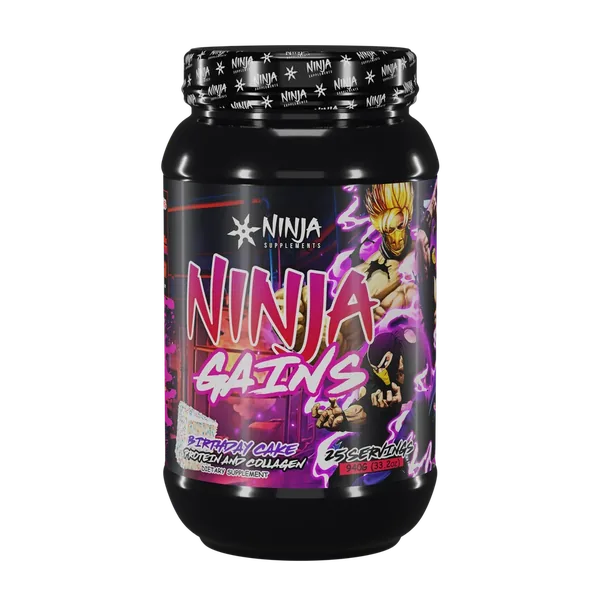
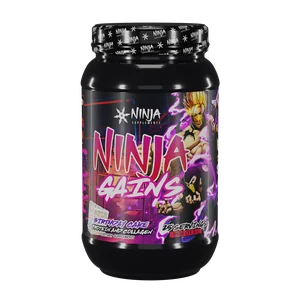
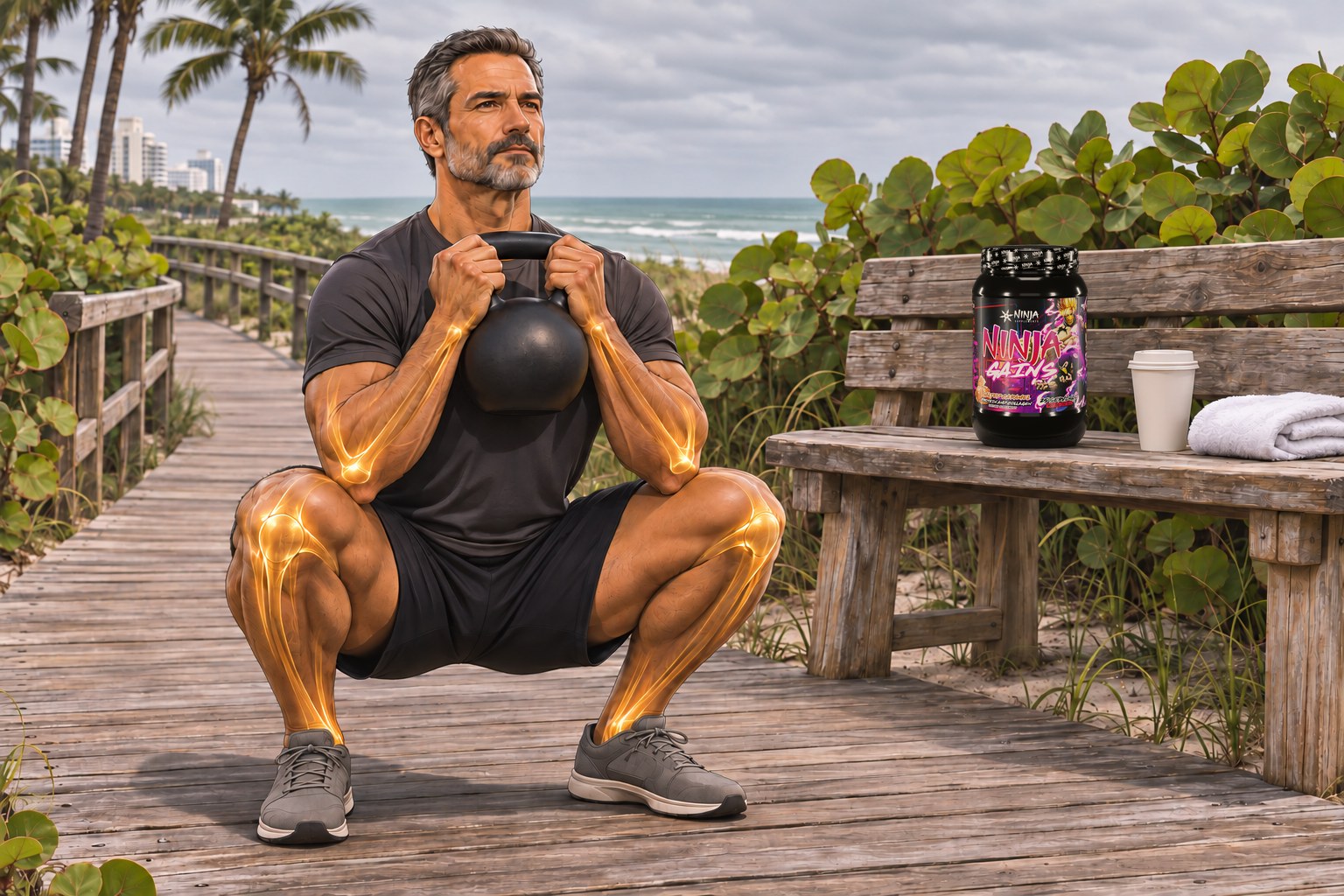
- Ninja Gains holds 11 g of hydrolyzed collagen a scoop, inside the 5 to 15 g a day the joint and training trials used, beside 21 g of complete protein from whey protein isolate.
What Does Collagen Actually Do in Your Body?
Collagen is the protein your body builds its rigging from: it makes up about 30% of all the protein in you, and type I, about 90% of your collagen, gives structure to skin, bones, tendons and ligaments (Cleveland Clinic). Think of a sailboat at Dinner Key: the muscles are the engine, but the boat goes nowhere without the lines and the rigging holding the mast up. Tendons tie muscle to bone, ligaments tie bone to bone, and collagen is their main building block.
A collagen supplement does not travel to your knee in one piece. Your gut breaks it into amino acids and small peptides, as it does with any protein you eat. Hydrolyzed collagen is collagen already cut into small peptides; gelatin is another form of the same protein. In a 2017 study, 15 g of gelatin raised the collagen building blocks in the blood (glycine, proline, hydroxyproline and hydroxylysine), which peaked about an hour later. So the question is not whether it gets in. It is whether those building blocks change anything you can measure.
Do Collagen Supplements Help Your Joints?
For athletes whose knees hurt from training, a little, in two trials that ran for months. Penn State gave 147 varsity and club athletes with activity-related joint pain, and no sign of a joint condition, 10 g of collagen hydrolysate or a placebo every day for 24 weeks (2008). Pain when walking, standing, carrying and lifting fell more on collagen than on placebo. The catch: only 97 of the 147 could be analysed at the end, and the placebo group improved too.
A German trial gave 139 athletes with knee pain during sport 5 g of collagen peptides or a placebo daily for 12 weeks (2017). Pain during activity fell 19.5 points on the trial’s pain scale with collagen against 13.9 with placebo, a gap of 5.6 points; pain at rest improved in both groups, with no real gap between them. One of its authors worked at a collagen research institute. A 2021 review of 15 trials came to the same place: joint comfort and function are where collagen looks most useful. Modest, and no substitute for fixing the squat that hurts.

Coach’s Corner: The Tendon Session
- Rope skipping: 6 rounds of 1 minute, 30 seconds rest. Light on the balls of your feet, wrists turn the rope, knees soft. The tendon studies used six minutes of continuous rope; rounds make it easier.
- Slow calf raise off a step: 3 x 12, 60 seconds rest. Up in one second, three seconds down, heels sinking just below the step.
- Wall sit: 3 x 30 to 45 seconds, 60 seconds rest. Back flat on the wall, thighs level with the floor, knees over your ankles.
- Tempo goblet squat: 3 x 8 to 10, 90 seconds rest. Three seconds down, chest up, knees tracking over your toes, heels down.
- Dead hang from a pull-up bar: 3 x 20 to 30 seconds, 60 seconds rest. Shoulders drawn down away from your ears, ribs down.
Run it as the opening of leg day or on its own, twice a week. The American College of Sports Medicine’s progression rule applies: when you beat your target with clean form, add 2 to 10% to the load. Healthy adults: if you have an injury, pain, a heart condition, or you are new to training, check with your doctor before you start. Stop if it hurts.
Can Collagen Help Your Tendons and Ligaments?
Maybe, and the most interesting lead is timing: collagen with vitamin C about an hour before you load the tendon. In the 2017 study, eight healthy men drank 0, 5 or 15 g of gelatin in a drink carrying 48 mg of vitamin C, waited an hour, then skipped rope for six minutes. On 15 g, a blood marker of new type I collagen being made doubled. Serum taken an hour after the gelatin also raised the collagen content of ligaments grown in the lab.
The follow-up (2019) ran the same protocol in 10 recreationally active men with 15 g of gelatin or of hydrolyzed collagen: the marker tended to rise about 20% with both, but the results varied too much to count as significant. The 2024 meta-analysis found tendon structure improved with collagen and training, but rated that evidence “very low” certainty. A promising lead built on very few people. Cheap to test on yourself, and nothing to bet a torn tendon on.
Does Collagen Build Muscle?
Not the way whey does, because collagen is not a complete protein. It lacks tryptophan, an essential amino acid, and is low in the others (Nutrients, 2019). In a McMaster University trial, 22 women in their late sixties took 30 g of whey or 30 g of collagen twice a day for six days. Whey raised muscle protein synthesis at rest and after exercise; collagen raised it only briefly after exercise, and not measurably over the six days.
So why do the training trials show more fat-free mass? In a 2019 trial, 57 young men lifted three times a week for 12 weeks on 15 g of collagen or a placebo. The collagen group gained more fat-free mass and did not gain the fat the placebo group did, but their muscle fibres grew no more than the placebo group’s. The authors’ own guess: the extra was connective tissue, not muscle. Collagen is the rigging; for the engine you still need a complete protein, which is why all the essential amino acids matter.
Do Collagen Supplements Work for Skin?
The honest answer in 2026 is unproven. A 2021 meta-analysis of 19 studies and 1,125 people (95% women) found better skin hydration, elasticity and wrinkles after about 90 days of hydrolyzed collagen. Then a 2025 meta-analysis of 23 trials and 1,474 people split the trials by who paid for them: the studies funded by companies showed the effect, and the studies with no company funding showed none. The high-quality studies showed no effect either. If the skin is your reason to buy collagen, that is worth knowing before you pay for a tub.
How Much Collagen Should You Take, and When?
5 to 15 g a day, every day, for 8 to 24 weeks; for tendons, 15 g with vitamin C about an hour before activity. Here is each goal with the dose that was actually tested:
| Your goal | What the trials used | How long | How strong the evidence is |
|---|---|---|---|
| Knees that hurt from training | 5 g or 10 g a day | 12 to 24 weeks | Modest, two trials, placebo groups improved too |
| Tendons and ligaments | 15 g with vitamin C, about 1 hour before activity | Days (blood markers) | Early: 8 and 10 men |
| Fat-free mass while lifting | 15 g a day | 12 weeks | Moderate certainty; may be connective tissue, not muscle |
| Building muscle itself | Whey or another complete protein | Every meal | Whey beat collagen head to head |
| Skin | Doses varied | About 90 days | No effect in independent or high-quality trials |
One practical rule falls out of that: collagen counts toward your daily protein, but it should not be the protein you rely on to build muscle (how much you need in a day is in How Much Protein Do You Need a Day?).
The Fuel Plan
| 80 kg (176 lb) lifter | 100 kg (220 lb) lifter | |
|---|---|---|
| Daily protein, 1.4 to 2.0 g per kg (ISSN) | 112 to 160 g | 140 to 200 g |
| 11 g of collagen as a share of that | 7 to 10% | 5.5 to 8% |
| Complete protein a meal, 0.25 g per kg (ISSN) | 20 g | 25 g |
| Vitamin C with it (USDA) | One medium navel orange (140 g) carries about 83 mg; the 2017 tendon study’s drink carried 48 mg | |
| Collagen from food (USDA) | One envelope (7 g) of unflavored gelatin, 6 g of protein | |
| When the scoop goes in | About an hour before the session, with an orange, for the timing the tendon studies used (they gave 15 g), or after training or between meals for the protein | |
| The scoop in your macros (label) | Ninja Gains Birthday Cake: 140 calories, 32 g protein, 3 g carbs, 1 g sugar a scoop | |
These are general numbers for healthy adults. With kidney disease, diabetes or any medical diet, ask your doctor or a registered dietitian.

Where Ninja Gains Fits
The trials used 5 to 15 g of collagen a day. One scoop of Ninja Gains holds 11 g of hydrolyzed bovine collagen, types I and III, beside 21 g of complete protein from whey protein isolate. The 11 g sits above the 5 g and 10 g of the knee trials and below the 15 g the tendon and lifting studies used. The 21 g of whey supplies the complete protein collagen lacks, and covers the ISSN’s 20 g a meal for an 80 kg lifter on its own. Rigging and engine, one scoop.
We will not tell you it rewinds your skin; the best trials say it does not. What we will say: if you were going to take collagen for your knees and Achilles anyway, and you need a protein shake after training anyway, this is the tub that puts both in one scoop, with every amount printed on the label.
Who it’s for: lifters who want a collagen dose inside the range the trials used and a complete whey protein in the same shake, an hour before training or after it. Who it’s not for: anyone avoiding dairy, soy or beef (Peanut Butter Candy also contains peanuts), vegans, and anyone after a meal replacement.
Ninja Gains: The Doses This Article Is About
Per serving, straight from the label. Protein per scoop: 32 g Birthday Cake, 31 g Salted Caramel, 33 g Peanut Butter Candy. The full label is on the product page.
| Hydrolized Bovine Collagen (Providing Type I and III Collagen) | 11000 mg |
| Provon®292 SFL (Instantized Whey Protein Isolate 90% delivering 21g of Complete Protein) (Cross-flow) microfiltration process. Instantized with Sunflower Lecithin) | 23000 mg |
The numbers: $57.99 for 25 scoops is $2.32 a scoop, or $1.97 with Subscribe and Save (15% off: $49.29 a tub each month, three deliveries to start, then cancel any time). Those three deliveries are 75 scoops, about 11 weeks of a scoop a day, close to the 12 weeks of the knee trial: run the trial on yourself. In stock today: Birthday Cake, Peanut Butter Candy and Salted Caramel.
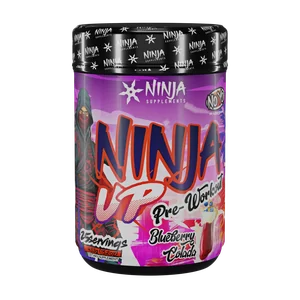
Most often bought with it: Ninja Up, our high-stim pre-workout for experienced users, one scoop before the session and Ninja Gains after.
Best protein I've tried so far. I love the added collagen. Taste is incredible.
Wow! Ninja Gains has absolutely everything I want in a protein now! 2G Grams of velositol! And the 11 grams of collagen! Why would anyone use any other protein?
Best taste and macros of ALL proteins
Ninja Gains contains milk and soy, and Peanut Butter Candy also contains peanuts; its collagen comes from cattle. If you take prescription medication, check with your doctor first. Free US shipping starts at $150.
Frequently Asked Questions
Do collagen supplements really work?
For some jobs, modestly. Trials in athletes found less joint pain during activity after 12 to 24 weeks, and a 2024 meta-analysis found a little more fat-free mass and strength with training. Collagen builds muscle less than whey, and independent skin trials found no effect.
What is the best type of collagen to take?
The trials used hydrolyzed collagen peptides or gelatin at 5 to 15 g a day, and in a 2019 study the two raised blood amino acids by about the same amount; your gut breaks either into amino acids and small peptides. Type I makes up about 90% of the collagen in your body. Ninja Gains’ collagen is types I and III, from cattle.
Which foods are rich in collagen?
Gelatin, a form of collagen: one 7 g envelope of unflavored gelatin carries 6 g of protein. Your body also makes its own collagen from glycine and proline, found in meat, fish, chicken and pork skin, egg whites and peanuts, and it needs vitamin C to do it, from oranges, strawberries and bell peppers.
Is collagen safe for everyone?
Not for everyone: collagen comes from animals (Ninja Gains’ from cattle), so it does not suit vegans or anyone avoiding beef, and Ninja Gains also contains milk and soy. The trials here were in healthy adults taking 5 to 15 g a day for up to 24 weeks. The FDA does not approve dietary supplements before they are sold; if you take prescription medication, ask your doctor first.
How long does collagen take to work?
Months, not days. The joint trials ran 12 and 24 weeks, the training trials at least 8 weeks, and the skin studies about 90 days. Take it daily and judge it after three months.
Can collagen replace your protein powder?
No. Collagen lacks tryptophan, an essential amino acid, and in a head-to-head trial whey raised muscle protein synthesis more, while over six days collagen did not raise it measurably. Use a complete protein for muscle and count collagen as extra.
Next read: How Do You Choose the Best Protein Powder?, for the six label checks that tell you what is really in a scoop, collagen included. And when the rigging and the engine both need feeding, Ninja Gains is one scoop.
Sources
- Bischof K, Moitzi AM, Stafilidis S, König D. Impact of Collagen Peptide Supplementation in Combination with Long-Term Physical Training on Strength, Musculotendinous Remodeling, Functional Recovery, and Body Composition in Healthy Adults: A Systematic Review with Meta-analysis. Sports Medicine, 2024.
- Oikawa SY, et al. Whey protein but not collagen peptides stimulate acute and longer-term muscle protein synthesis with and without resistance exercise in healthy older women: a randomized controlled trial. American Journal of Clinical Nutrition, 2020.
- Kirmse M, et al. Prolonged Collagen Peptide Supplementation and Resistance Exercise Training Affects Body Composition in Recreationally Active Men. Nutrients, 2019.
- Clark KL, et al. 24-Week study on the use of collagen hydrolysate as a dietary supplement in athletes with activity-related joint pain. Current Medical Research and Opinion, 2008.
- Zdzieblik D, et al. Improvement of activity-related knee joint discomfort following supplementation of specific collagen peptides. Applied Physiology, Nutrition, and Metabolism, 2017 (one author from a collagen research institute).
- Shaw G, et al. Vitamin C-enriched gelatin supplementation before intermittent activity augments collagen synthesis. American Journal of Clinical Nutrition, 2017.
- Lis DM, Baar K. Effects of Different Vitamin C-Enriched Collagen Derivatives on Collagen Synthesis. International Journal of Sport Nutrition and Exercise Metabolism, 2019.
- Khatri M, et al. The effects of collagen peptide supplementation on body composition, collagen synthesis, and recovery from joint injury and exercise: a systematic review. Amino Acids, 2021.
- de Miranda RB, Weimer P, Rossi RC. Effects of hydrolyzed collagen supplementation on skin aging: a systematic review and meta-analysis. International Journal of Dermatology, 2021.
- Myung SK, Park Y. Effects of Collagen Supplements on Skin Aging: A Systematic Review and Meta-Analysis of Randomized Controlled Trials. American Journal of Medicine, 2025.
- Paul C, Leser S, Oesser S. Significant Amounts of Functional Collagen Peptides Can Be Incorporated in the Diet While Maintaining Indispensable Amino Acid Balance. Nutrients, 2019 (one author from a collagen maker and one from a collagen research institute).
- Jäger R, et al. International Society of Sports Nutrition Position Stand: protein and exercise. Journal of the International Society of Sports Nutrition, 2017.
- American College of Sports Medicine. American College of Sports Medicine position stand. Progression models in resistance training for healthy adults. Medicine and Science in Sports and Exercise, 2009.
- Cleveland Clinic. Collagen: What It Is, Types, Function and Benefits. Read 8 November 2026.
- US Food and Drug Administration. Questions and Answers on Dietary Supplements. Read 8 November 2026.
- US Department of Agriculture. FoodData Central (SR Legacy: navel orange, raw; gelatin, dry powder, unsweetened), read 8 November 2026.
How we wrote this: we wrote this page because “collagen supplement” is searched about 550,000 times a month in the US, more than three times as often as a year earlier (Google Ads Keyword Planner, September 2026), and Google’s answers for it lean on skin while lifters ask about joints and tendons. We read the meta-analyses, trials and reviews above, took every food number from USDA FoodData Central, checked every Ninja Gains number against its labels, and took the price and flavours from the store on 8 November 2026. These statements have not been evaluated by the Food and Drug Administration. This product is not intended to diagnose, treat, cure, or prevent any disease.