

You’re standing in a convenience store at 5:45 AM, staring at a wall of canned energy drinks. You’ve got a heavy leg day in 45 minutes. You grab one. It’s quick, it’s familiar, it’ll get you going. Sound familiar? Millions of gym-goers make this exact decision every day, not realizing they’re essentially bringing a Swiss Army knife to a surgery.
Energy drinks and pre-workout supplements might both promise energy and focus, but they’re fundamentally different tools built for entirely different purposes. Let’s break down exactly what separates them, ingredient by ingredient, benefit by benefit, so you can make a smarter decision before your next session.
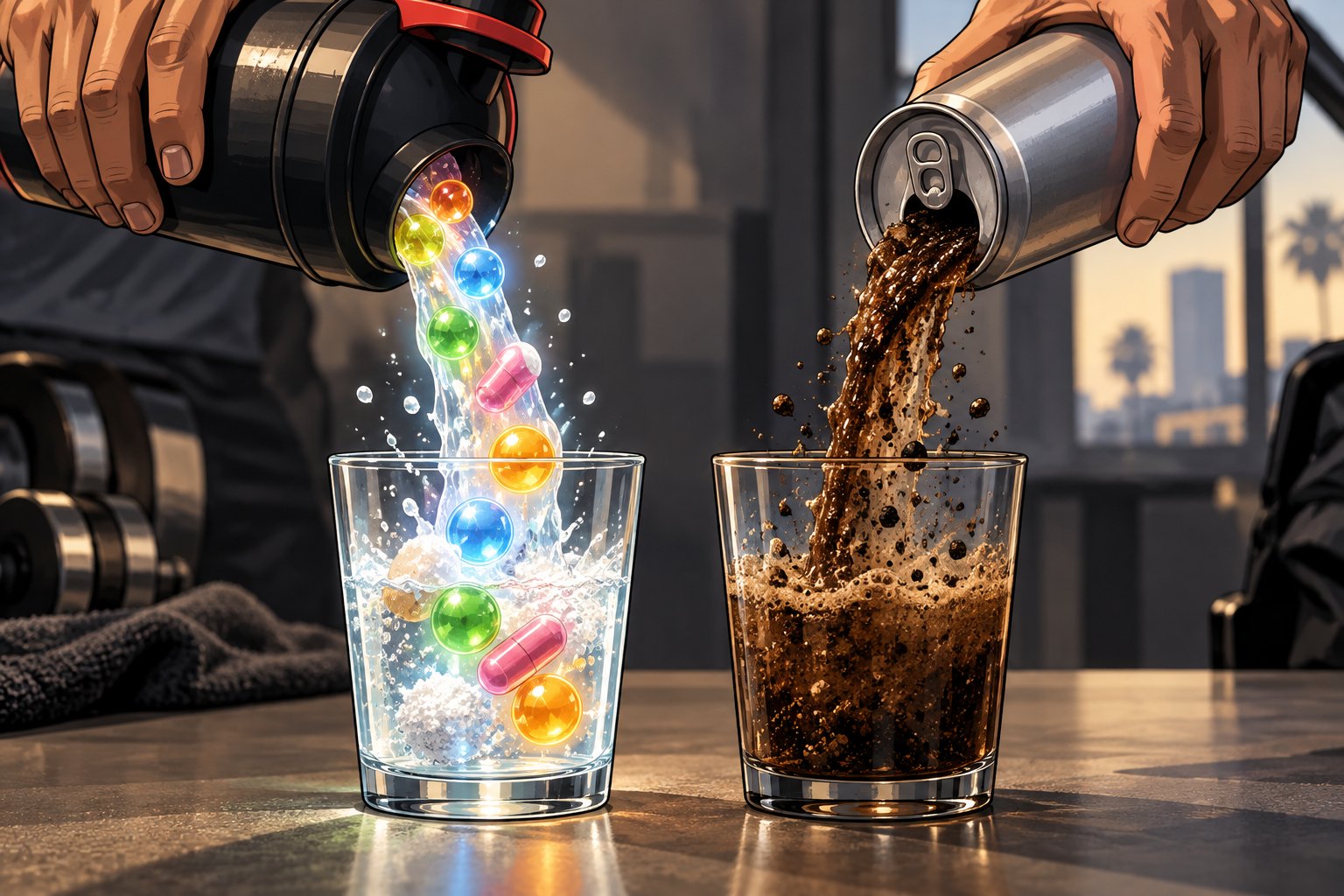
This is where the conversation really starts. Understanding what’s inside your supplement is non-negotiable. At Ninja Supplements, we live by clinically dosed ingredient transparency, meaning you should know exactly what you’re consuming and why every milligram matters.
Popular energy drinks typically contain:
The core goal of an energy drink is simple: deliver fast energy through caffeine and sugar (or caffeine alone in “sugar-free” versions). They’re designed for general alertness: keeping you awake during a long drive, powering through an afternoon work slump, or cracking open at a music festival. They were never formulated to optimize athletic performance.
A quality pre-workout supplement is an entirely different animal. The best pre-workout formulas are engineered specifically to enhance athletic performance across multiple physiological pathways. Here’s what a clinically dosed pre-workout typically includes:
Notice the clinical doses. This isn’t marketing fluff. These are the dosages backed by peer-reviewed research. According to the National Institutes of Health research on exercise supplementation, ingredients like L-citrulline and beta-alanine demonstrate measurable performance benefits at these specific dosage thresholds. Underdose them and you’re essentially paying for expensive placebo.
When you compare the actual pre-workout benefits to what energy drinks deliver, the gap becomes obvious fast.
Energy drinks give you one dimension: caffeine-fueled alertness. A well-formulated pre-workout delivers a multi-system performance upgrade. If your goal is to crush your workout, maximize your sets, and push past previous limits, there’s a clear winner here.
Both products deliver caffeine, but how they deliver it matters enormously, especially if you’re someone with a higher stimulant tolerance chasing serious performance.
Energy drinks commonly use caffeine from various sources with inconsistent absorption rates, mixed with large amounts of sugar that create a glycemic spike followed by a hard crash, exactly what you don’t want mid-workout.
A high stim pre-workout takes a more sophisticated approach. Many formulas stack caffeine anhydrous with slower-releasing caffeine sources or pair it with L-theanine (typically at a 1:2 caffeine-to-theanine ratio) to smooth out the stimulant curve. This delivers clean, sustained energy that keeps you locked in from warm-up to final set without the jittery spike-and-crash cycle.
For experienced gym-goers who’ve built up stimulant tolerance, the higher caffeine ceiling in premium pre-workouts (some reaching 300–400mg of total caffeine) is another meaningful advantage. Most energy drinks simply can’t match that without stacking multiple cans, which introduces excessive sugar, artificial additives, and unpredictable ingredient combinations.
The FDA’s consumer guidance on dietary supplements recommends understanding exactly what’s in any supplement you consume, a standard that clinically dosed pre-workouts are built to meet and energy drinks often fall short of.
Here’s something energy drinks simply cannot replicate: the pump. That muscle-swelling, vascular, skin-tight sensation you get from a proper training session isn’t just cosmetic. It’s physiologically important.
When L-citrulline converts to L-arginine in the kidneys, it drives nitric oxide production, which dilates blood vessels and floods working muscles with oxygen, nutrients, and hydration. This isn’t just about looking jacked in the mirror: enhanced blood flow directly correlates with better endurance, faster nutrient delivery, and improved performance.
Energy drinks contain none of these nitric oxide precursors. They can’t give you a pump. Period. If you’re serious about maximizing performance and you want that next-level muscle fullness during your session, you need a dedicated pre-workout supplement with clinically dosed L-citrulline. Explore the full breakdown of what makes a formula elite in our guide to pre-workout supplements.
Energy drinks win on pure grab-and-go convenience. They’re at every gas station, grocery store, and vending machine. Pre-workouts require a bit more intentionality: measuring a scoop, mixing with water, timing your intake 20–30 minutes pre-session.
But the cost math tells a different story. Premium energy drinks run $3–$5 each. A quality pre-workout tub with 30 servings might cost $45–$60, breaking down to $1.50–$2.00 per serving, and delivers far more performance value per dose. When you factor in what you’re actually getting from each product, the pre-workout isn’t just more effective. It’s more economical.
The “convenience” of an energy drink becomes a lot less compelling when you realize you’re paying more for less performance.
Honesty matters here. Energy drinks aren’t useless. They’re just misapplied in the gym context. They’re genuinely useful for:
But if you’re walking into the gym, you deserve better. Your training session deserves a product formulated for the specific physiological demands you’re about to put on your body. That’s not an energy drink.
If you’re also interested in cognitive performance beyond the gym, our nootropics and focus energy guide covers how specific cognitive ingredients stack with pre-workout for total mental performance.
You can, but you’ll miss out on the performance-specific ingredients that make pre-workouts effective, like L-citrulline for pumps, beta-alanine for endurance, and betaine for power output. An energy drink provides caffeine-based alertness only, which is a fraction of what a dedicated pre-workout delivers for gym performance.
Pre-workouts are formulated with clinically dosed ingredients targeting multiple performance factors: muscular endurance, strength, blood flow, mental focus, and hydration. Energy drinks target one pathway (caffeine-driven alertness) and lack the nitric oxide precursors, endurance buffers, and power-support compounds found in quality pre-workouts.
It depends on your stimulant tolerance and training intensity. Moderate options start around 150–200mg for caffeine-sensitive individuals. Experienced gym-goers with higher tolerance often use high stim pre-workouts ranging from 250–400mg. Always start with the lower end when trying a new formula and assess your tolerance.
Most healthy adults can use pre-workouts regularly, but cycling off periodically (every 8–12 weeks) helps prevent stimulant tolerance buildup. Always read the label, respect serving sizes, and consult a healthcare professional if you have any underlying cardiovascular conditions. Science-backed transparency in ingredient dosing makes managing this much easier.
A high stim pre-workout features elevated stimulant content, typically 300mg+ of caffeine, often combined with additional energy compounds. These are designed for experienced athletes who’ve built stimulant tolerance and need stronger activation for intense training sessions. They’re not recommended for beginners or caffeine-sensitive individuals.
The pre-workout vs energy drinks debate isn’t really a close contest for serious gym-goers. Energy drinks are general-purpose caffeine delivery systems. Pre-workout supplements are precision performance tools: scientifically formulated, clinically dosed, and purpose-built to help you train harder, push further, and recover better between sets.
If you’re going to put in the work in the gym, invest in the tool designed for the job. Stop leaving performance gains on the table with a product that was never built for what you’re asking it to do.
Ready to find the right formula for your training style and tolerance? Explore our full science-backed breakdown of the best pre-workout supplements and discover what clinically dosed, transparent formulation actually looks like. Your best session is waiting.
† These statements have not been evaluated by the Food and Drug Administration. This product is not intended to diagnose, treat, cure, or prevent any disease.