



Lift two or three times a week, about ten hard sets a muscle, and eat about 1.6 g of protein per kilo: muscle still grows after 35. Across 49 studies of 1,328 adults aged 50 and over, resistance training added an average of 1.1 kg of lean mass, and the higher-volume programs added the most. The limit: gains came a little smaller with age, so the plan has to be steady.
Searches for “how to build muscle” run at about 201,000 a month in the US, more than seven times a year ago, and training searches climb into January. This one is for the man with a job, a family and three hours a week: the trials’ numbers, turned into a plan for Monday.
The Short Version
- Volume builds it: in a 2017 meta-analysis of 15 studies, every extra weekly set added about 0.37% more growth, and groups doing 10 or more sets a muscle a week tended to grow the most (Journal of Sports Sciences, 2017).
- Load is your choice: across 21 studies, light and heavy loads taken to failure built about the same muscle; heavy loads built more maximal strength (Journal of Strength and Conditioning Research, 2017).
- Protein has a ceiling: across 49 trials and 1,863 people, extra protein stopped adding lean mass at about 1.6 g per kilo of body weight a day (British Journal of Sports Medicine, 2018).
- Ninja Gains holds 31 to 33 g of protein a scoop by flavour; its 21 g of complete whey protein sits inside the ISSN’s 20 to 40 g a meal.
Is It Harder to Build Muscle After 35?
A little, not a lot: muscle still grows at 35, 45 and 65, but each decade asks a bit more of your training and your plate. In that 2011 meta-analysis, higher-volume programs went with bigger gains and older groups gained a little less, and a man of 38 is far nearer in age to the young lifters most trials study.
Two things change. The first is protein. In a 2015 pooled analysis of lab studies, men of about 71 needed about 0.40 g of protein per kilo in a single meal to max out muscle building, against 0.24 g in men of about 22. The second is practical: at 40 your joints and your calendar need as much planning as your muscles, so the plan below keeps the reps clean and leaves a rep or two in the tank.
How Many Sets a Week Does It Take to Grow?
About 10 hard sets a muscle a week is the working target; more can add more, with shrinking returns. The 2017 meta-analysis by Schoenfeld and colleagues found a dose response: each extra weekly set added about 0.37% to the gain, and groups doing 10 or more sets a muscle tended to grow the most. A 2026 set of meta-regressions on 67 studies and 2,058 people agreed that more sets built more muscle, and found the returns shrinking as the sets piled up.
A set counts when it ends within a few reps of failure; warm-ups do not. Count per muscle: a squat counts for your thighs, a bench press for your chest. New to lifting? Start nearer 5 sets a muscle a week and build up.
For a busy week, that means three full-body sessions of about 15 to 20 sets each, which lands most big muscles at 9 to 15 sets a week without a single two-hour night in the gym.
How Heavy Should You Lift, and How Close to Failure?
Any weight you can lift for about 6 to 15 good reps works for size, as long as each set ends 1 to 3 reps short of failure. Across 21 studies where every set went to failure, light loads (60% of a one-rep max or less) and heavy loads built about the same muscle; heavy loads won only on maximal strength. A 2023 meta-analysis of 119 studies and 3,364 people found all prescriptions built similar muscle; heavy multiple sets twice weekly ranked first.
Failure itself is optional: a 2023 meta-analysis of 15 studies found no clear advantage for sets taken all the way to failure. Past 35 that is good news. Stop when the next rep would break your form.
Rest matters too. In an 8-week trial of 21 young trained men, 3 minutes’ rest between sets built more strength and thigh muscle than 1 minute. Give the big lifts 2 to 3 minutes.
| The lever | What the trials found | Your setting |
|---|---|---|
| Sets a muscle a week | more sets, more growth, shrinking returns (15 studies; 67 studies) | about 10, from 9 to 15 |
| Load | light and heavy built similar muscle near failure (21 studies) | a weight you can lift 6 to 15 times |
| Effort | no clear edge for going to failure (15 studies) | stop 1 to 3 reps short |
| Rest | 3 minutes beat 1 minute for size and strength (21 men, 8 weeks) | 2 to 3 minutes on big lifts |
| Each muscle | twice a week beat once (10 studies) | two or three times a week |
How Often Should You Train Each Muscle?
At least twice a week: in a 2016 meta-analysis of 10 studies, training a muscle twice a week built more than once, with the weekly sets held equal. Whether three times beats two was still open in that review, and the 2026 meta-regressions found frequency made little difference to size once weekly sets were set. So frequency is a tool for spreading the sets, not a goal of its own.
So the plan below is full body, three days a week: each session stays short, and a missed day costs a third of a muscle’s week, not all of it. The US Physical Activity Guidelines ask adults for muscle-strengthening work on 2 or more days a week; this clears it with a day to spare.
Coach’s Corner: The Three-Day Grinder Plan
- Warm-up: 8 to 10 minutes on an easy bike or rower, then two light ramp-up sets of the first lift.
- Goblet squat: 3 x 8 to 12, 2 to 3 minutes rest. Elbows inside the knees, chest tall, sit down between your heels.
- Dumbbell Romanian deadlift: 3 x 8 to 12, 2 to 3 minutes rest. Push the hips back, soft knees, the dumbbells close to your legs, back flat.
- Dumbbell bench press: 3 x 8 to 12, 2 minutes rest. Shoulder blades pinched back, elbows about 45 degrees from your sides.
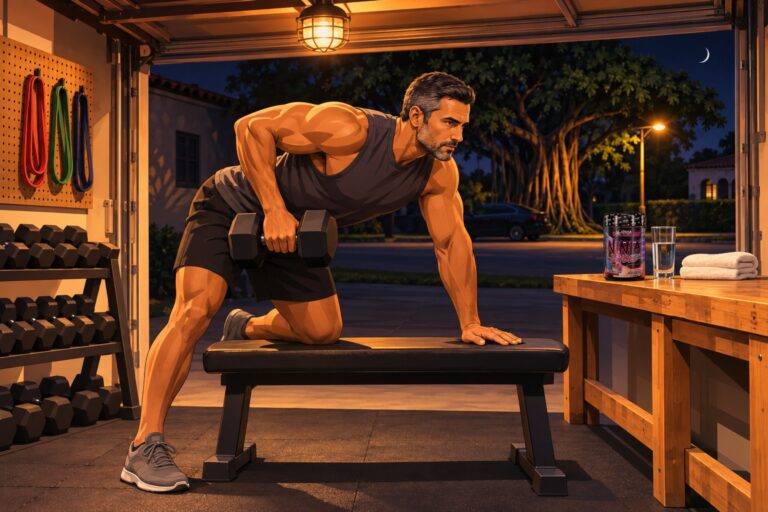
- One-arm dumbbell row: 3 x 10 to 12 each side, 90 seconds rest. Pull the elbow to your back pocket, no twisting.
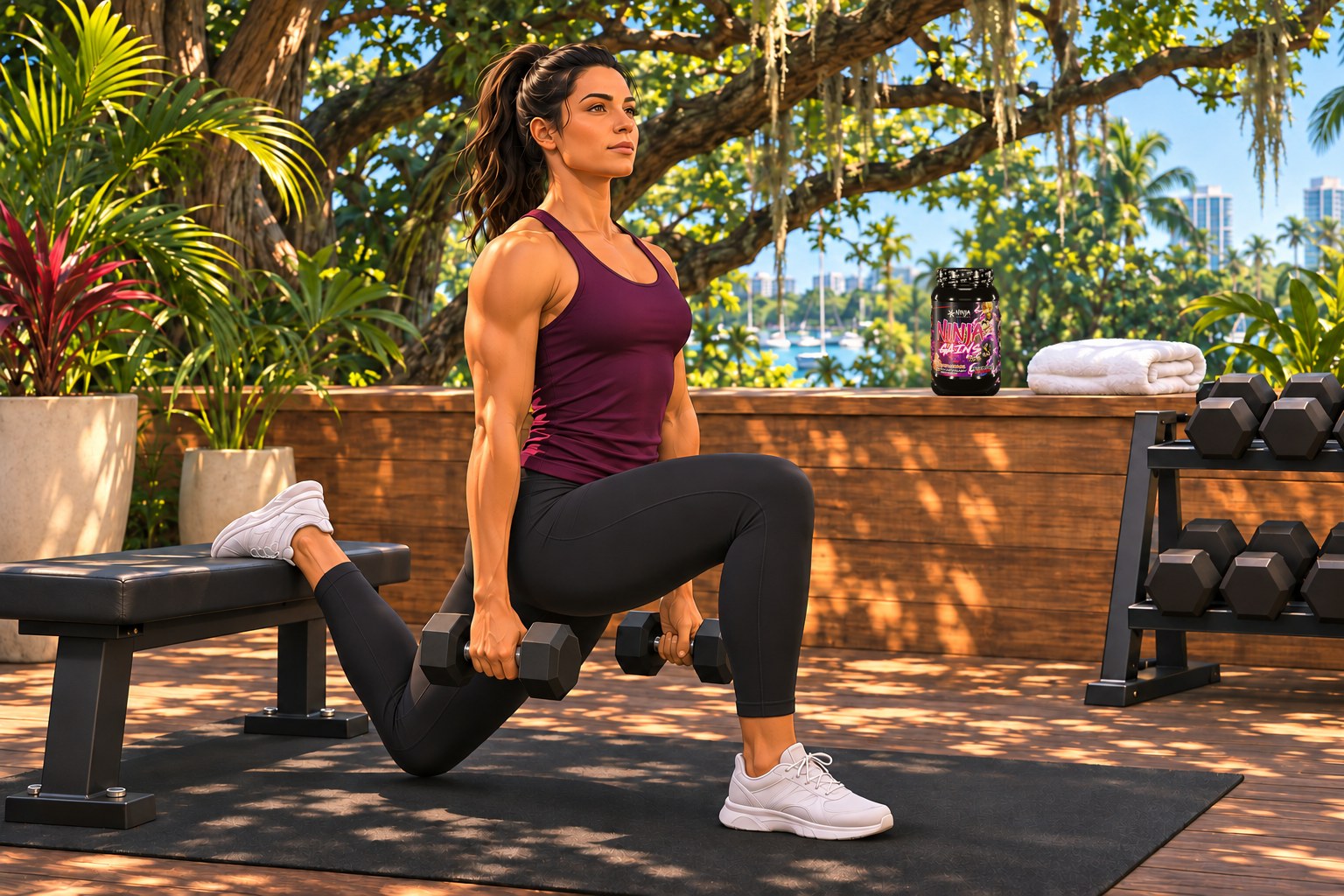
- Rear-foot-elevated split squat: 2 x 8 to 10 each leg, 90 seconds rest. Back foot on a bench, front shin near vertical, lower straight down.
Monday, Wednesday and Friday, or any three days with a rest day between, the same moves each time. Every set ends 1 to 3 reps short of failure. When you hit the top of the rep range on every set of a move, add the smallest weight jump next session. About 50 to 60 minutes with the warm-up. Healthy adults: if you have an injury, pain, a heart condition, or you are new to training, check with your doctor before you start. Stop if it hurts.
What Should You Eat to Build Muscle?
Enough protein first: about 1.6 g per kilo of body weight a day, spread over four meals of roughly 30 to 40 g each. The 2018 meta-analysis of 49 trials found protein supplements added about 0.30 kg of lean mass on top of training, and the benefit stopped growing at about 1.62 g per kilo a day. The International Society of Sports Nutrition puts the range at 1.4 to 2.0 g per kilo, in doses of 20 to 40 g every 3 to 4 hours.
Why 30 to 40 g rather than 20: the ISSN’s 0.25 g per kilo a dose is 20 g for an 80 kg man, but it says the dose depends on age, and the older men in that 2015 analysis needed about 0.40 g per kilo. A lifter in his forties sits somewhere between, and 30 to 40 g a meal clears both figures for most lifters. The ISSN adds that each dose should carry 700 to 3,000 mg of leucine.
Eat enough overall to grow, and sleep: adults should get 7 or more hours a night, and our article on how poor sleep cuts into your gains has the numbers for lifters. For every protein question in depth, see How Much Protein Do You Actually Need a Day?
The Fuel Plan
| The number | 80 kg lifter | 100 kg lifter |
|---|---|---|
| Protein a day at the 1.6 g per kg plateau (Morton 2018) | 128 g | 160 g |
| The ISSN range (1.4 to 2.0 g per kg) | 112 to 160 g | 140 to 200 g |
| Protein a meal (0.25 to 0.40 g per kg) | 20 to 32 g | 25 to 40 g |
| Meals with protein | 4, every 3 to 4 hours | 4, every 3 to 4 hours |
| Sleep | 7 hours or more | 7 hours or more |
| Food first (USDA) | 150 g roasted chicken breast, 47 g protein; 150 g cooked salmon, 33 g; 3 hard-boiled eggs, 19 g; 170 g plain nonfat Greek yogurt, 16 g; a cup of cooked lentils, 18 g | |
| A day that gets there | Breakfast: the eggs and the yogurt, 35 g. Lunch: the chicken, 47 g. After training: one scoop of Ninja Gains, 31 to 33 g. Dinner: the salmon, 33 g. About 146 to 148 g: the 80 kg lifter is covered; the 100 kg lifter adds the lentils. | |
| The scoop in the day’s macros | Ninja Gains Birthday Cake: 140 calories, 32 g protein, 3 g carbs, 1 g sugar a scoop (Salted Caramel 130 calories and 31 g; Peanut Butter Candy 157 calories and 33 g) | |
These are general numbers for healthy adults. With kidney disease, diabetes or any medical diet, ask your doctor or a registered dietitian.
How Do You Keep Growing After the First Few Months?
Keep adding a little: one more rep at the same weight, or a little more weight at the same reps, and write it down. An 8-week trial of 43 trained lifters compared the two routes, adding load against adding reps, and found both built leg muscle about equally. So you do not need a new weight every week; you need the work to creep up.
The plan builds it in: climb the rep range, then add weight. Log every set on your phone. Stalled for three weeks? Check sleep, total protein and whether you really trained three times a week. Most of these trials ran 6 weeks or more, so judge the plan over months.
Missed a session? Do the next one. Achy knee? Lighten the split squat for a week, and if it still hurts, see a doctor. Steady years beat a perfect ten weeks.
Where Ninja Gains Fits
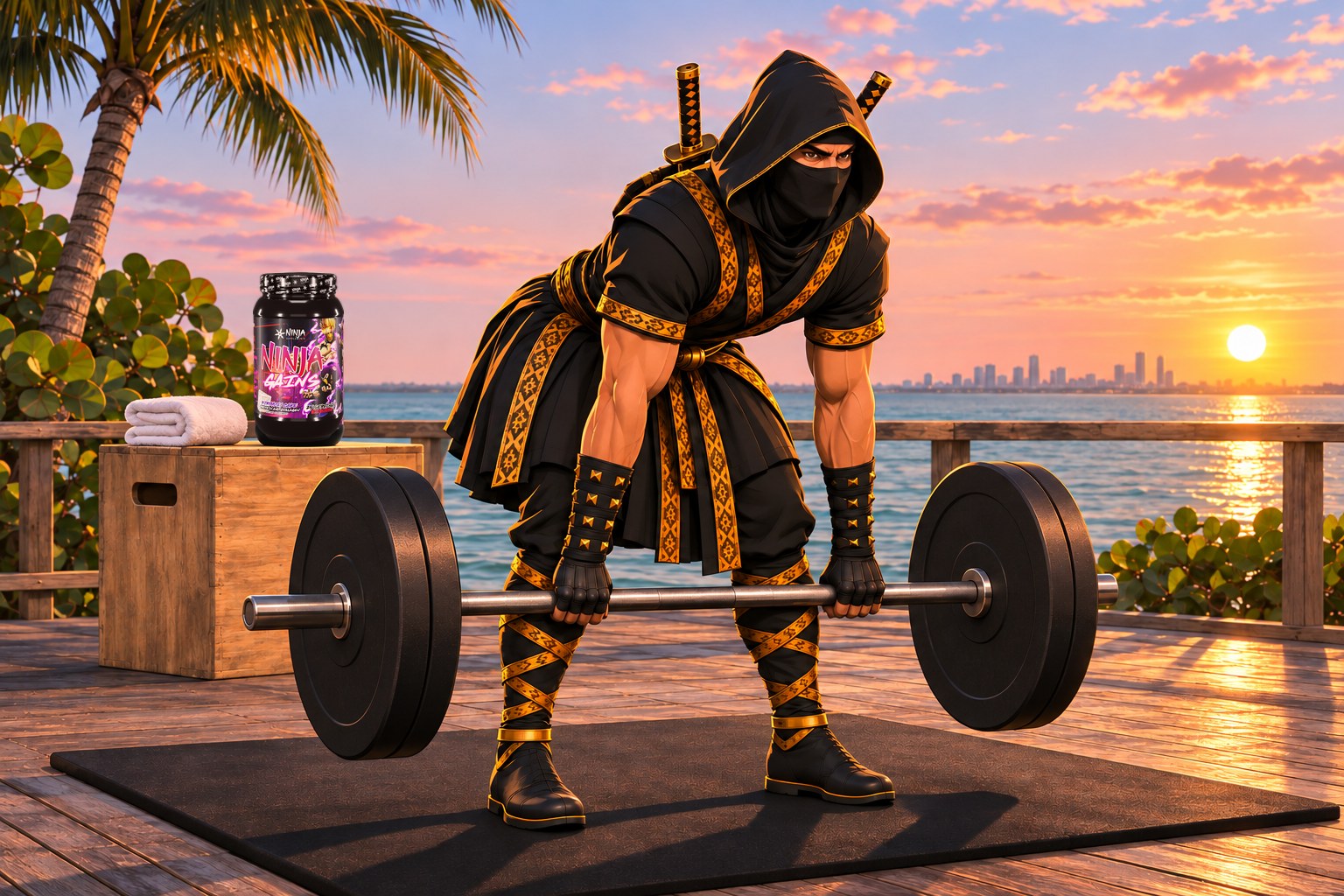
Ninja Gains is the scoop that closes the gap in that Fuel Plan: 31 to 33 g of protein a scoop by flavour, 21 g of it complete whey protein, inside the ISSN’s 20 to 40 g a dose. The label’s amino table puts 2,093 mg of leucine in that whey, inside the ISSN’s 700 to 3,000 mg. The other 11 g is collagen, not a complete protein: the whey is the muscle-building dose.
Train three times a week and come up 30 g short? One scoop after the session covers it.
Who it’s for: lifters who fall short of their protein number from food and want a top-up after training or between meals. Who it’s not for: anyone looking for a meal replacement, and anyone with a milk or soy allergy (Peanut Butter Candy also holds peanuts).
Ninja Gains: The Doses This Article Is About
Per serving, straight from the label. Protein per scoop: 32 g Birthday Cake, 31 g Salted Caramel, 33 g Peanut Butter Candy. The full label is on the product page.
| Provon®292 SFL (Instantized Whey Protein Isolate 90% delivering 21g of Complete Protein) (Cross-flow) microfiltration process. Instantized with Sunflower Lecithin) | 23000 mg |
| Hydrolized Bovine Collagen (Providing Type I and III Collagen) | 11000 mg |
The numbers: $57.99 for 25 scoops is $2.32 a scoop, or $1.97 with Subscribe and Save (15% off: $49.29 a tub). In stock today: Birthday Cake, Peanut Butter Candy and Salted Caramel.
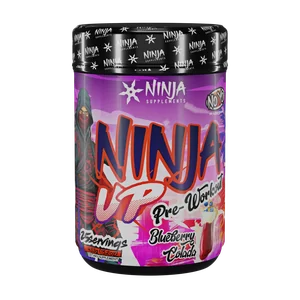
Most often bought with Ninja Gains: Ninja Up, our high-stim pre-workout for experienced caffeine users, one scoop before the session and Ninja Gains after it.
One of the best proteins out there ,it has collagen of course it's protein . It helps with building and repairing.
Best protein I've tried so far. I love the added collagen. Taste is incredible.
Wow! Ninja Gains has absolutely everything I want in a protein now! 2G Grams of velositol! And the 11 grams of collagen! Why would anyone use any other protein?
Ninja Gains contains milk and soy, and Peanut Butter Candy also contains peanuts; its collagen comes from cattle. If you take prescription medication, check with your doctor first. Free US shipping starts at $150.
Frequently Asked Questions
Can you build muscle after 40?
Yes. A meta-analysis of 49 studies of adults aged 50 and over found resistance training added an average of 1.1 kg of lean mass, more with higher-volume programs. Gains came a little smaller with age, so train each muscle twice a week or more and keep protein near 1.6 g per kilo a day.
How long should a muscle-building workout last?
Long enough for about 15 to 20 hard sets with proper rest: the three-day plan in this article runs about 50 to 60 minutes with its warm-up. In an 8-week trial, resting 3 minutes between sets built more muscle than resting 1.
Do you need protein powder to build muscle?
No. You need enough total protein, about 1.6 g per kilo a day, and food can supply it. A powder is a practical way to close the gap on busy days: the International Society of Sports Nutrition calls supplements a practical way to get enough high-quality protein without piling on calories.
Is collagen protein good for building muscle?
Not on its own. Collagen is not a complete protein, and in a 2020 trial in older women, whey raised muscle protein building far more than collagen did. Build each meal around complete protein, such as whey, meat, fish, eggs or dairy.
How long until you see results from lifting?
Judge it over months, not weeks. Most trials here ran 6 weeks or more before measuring growth. Track your reps and weights each week: rising numbers are the first sign the plan is working.
Next read: How Much Protein Do You Actually Need a Day?, if you want the protein maths for your own weight, meal by meal. And for the scoop after the session, Ninja Gains is the tub. Wondering about the collagen half of it? Do Collagen Supplements Actually Work? has the trials.
Sources
- Peterson MD, Sen A, Gordon PM. Influence of resistance exercise on lean body mass in aging adults: a meta-analysis. Medicine and Science in Sports and Exercise, 2011.
- Schoenfeld BJ, Ogborn D, Krieger JW. Dose-response relationship between weekly resistance training volume and increases in muscle mass: A systematic review and meta-analysis. Journal of Sports Sciences, 2017.
- Pelland JC, et al. The Resistance Training Dose Response: Meta-Regressions Exploring the Effects of Weekly Volume and Frequency on Muscle Hypertrophy and Strength Gains. Sports Medicine, 2026 (the authors are coaches and writers in the fitness industry).
- Schoenfeld BJ, Ogborn D, Krieger JW. Effects of Resistance Training Frequency on Measures of Muscle Hypertrophy: A Systematic Review and Meta-Analysis. Sports Medicine, 2016.
- Schoenfeld BJ, et al. Strength and Hypertrophy Adaptations Between Low- vs. High-Load Resistance Training: A Systematic Review and Meta-analysis. Journal of Strength and Conditioning Research, 2017.
- Currier BS, et al. Resistance training prescription for muscle strength and hypertrophy in healthy adults: a systematic review and Bayesian network meta-analysis. British Journal of Sports Medicine, 2023 (one author reports grants from dairy and nutrition companies).
- Refalo MC, et al. Influence of Resistance Training Proximity-to-Failure on Skeletal Muscle Hypertrophy: A Systematic Review with Meta-analysis. Sports Medicine, 2023 (two authors earn income as fitness writers and practitioners).
- Schoenfeld BJ, et al. Longer Interset Rest Periods Enhance Muscle Strength and Hypertrophy in Resistance-Trained Men. Journal of Strength and Conditioning Research, 2016.
- Plotkin D, et al. Progressive overload without progressing load? The effects of load or repetition progression on muscular adaptations. PeerJ, 2022 (one author advises an exercise equipment maker; two work for a training company).
- Morton RW, et al. A systematic review, meta-analysis and meta-regression of the effect of protein supplementation on resistance training-induced gains in muscle mass and strength in healthy adults. British Journal of Sports Medicine, 2018 (one author has received support from the US National Dairy Council).
- Moore DR, et al. Protein ingestion to stimulate myofibrillar protein synthesis requires greater relative protein intakes in healthy older versus younger men. The Journals of Gerontology, Series A, 2015.
- Jäger R, et al. International Society of Sports Nutrition Position Stand: protein and exercise. Journal of the International Society of Sports Nutrition, 2017.
- Oikawa SY, et al. Whey protein but not collagen peptides stimulate acute and longer-term muscle protein synthesis with and without resistance exercise in healthy older women: a randomized controlled trial. American Journal of Clinical Nutrition, 2020.
- Watson NF, et al. Recommended Amount of Sleep for a Healthy Adult: A Joint Consensus Statement of the American Academy of Sleep Medicine and Sleep Research Society. Sleep, 2015.
- US Department of Health and Human Services. Physical Activity Guidelines for Americans, 2nd edition. 2018.
- US Department of Agriculture. FoodData Central (SR Legacy: roasted chicken breast, cooked farmed Atlantic salmon, hard-boiled egg, plain nonfat Greek yogurt, boiled lentils), the figures our protein article read on 28 October 2026.
How we wrote this: we picked this topic because “how to build muscle” is searched about 201,000 times a month in the US, more than seven times a year ago, and Google’s first page for it is general guides, none built around a lifter past 35 with three hours a week. We read the meta-analyses, trials and position stands above, kept to studies in healthy adults, built the Coach’s plan to their numbers, and checked every Ninja Gains number against its labels and the live store on Tuesday 17 November 2026. These statements have not been evaluated by the Food and Drug Administration. This product is not intended to diagnose, treat, cure, or prevent any disease.