
Yes, and the lab can measure it. In a 2021 trial, one night without sleep cut muscle protein synthesis by 18% and testosterone by 24% in 13 healthy young adults, and on a diet, sleeping 5.5 hours instead of 8.5 made people lose 60% more lean mass over two weeks (2010). Sleep does not build muscle on its own, but short sleep taxes every set you do.
The searches around this question are all about hours: is 6 enough, can you train on 5, is 8 the number. So here is what the studies measured at each of those, and a night routine a lifter can actually run on a work night.
The Short Version
- One sleepless night: muscle protein synthesis down 18%, testosterone down 24%, cortisol up 21% the next day (13 adults, Physiological Reports, 2021).
- Five nights of 4 hours: muscle-building protein synthesis fell to 1.24% a day against 1.53% on 8 hours, and three interval sessions held it at 1.61% (24 young men, Journal of Physiology, 2020).
- The floor: adults should sleep 7 or more hours a night on a regular basis (American Academy of Sleep Medicine and Sleep Research Society, 2015).
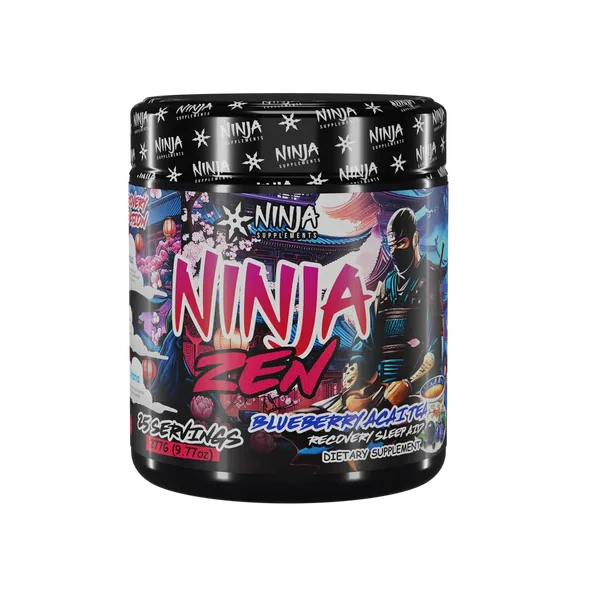
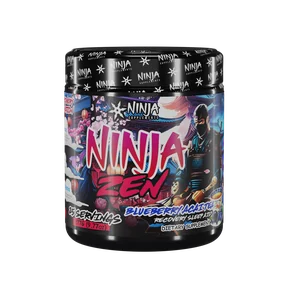
- Ninja Zen holds 350 mg of L-theanine a scoop, inside the 200 to 450 mg daily range a 2026 review of 13 trials landed on, plus 2 mg of melatonin, caffeine free.
How Does Sleep Affect Muscle Growth?
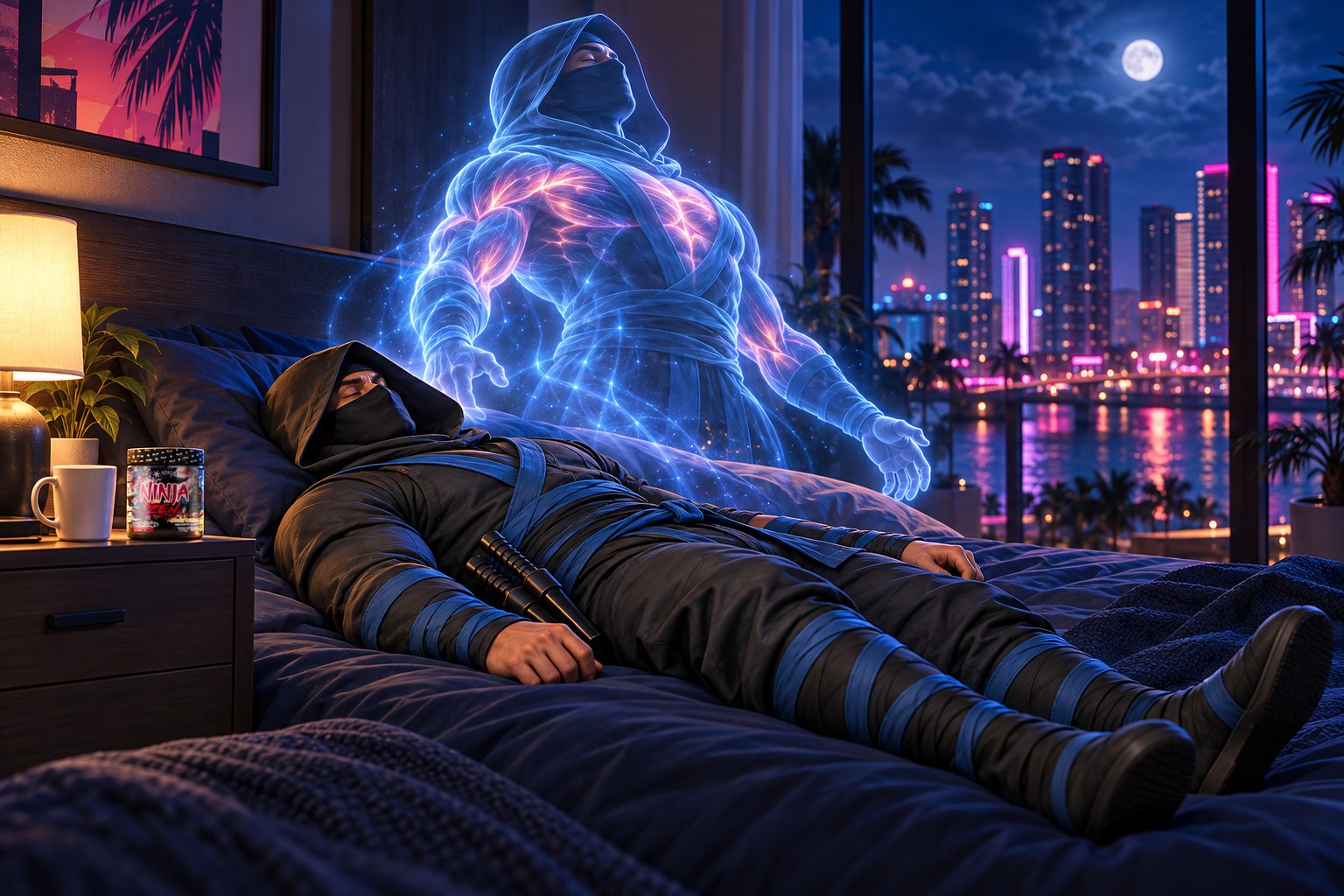
Through the main dial on muscle growth: muscle protein synthesis. In the 2021 trial, after one night awake, 13 healthy young adults built muscle protein 18% more slowly the next afternoon, with cortisol 21% higher and testosterone 24% lower than after a normal night. One night was enough to create what the authors called anabolic resistance and a procatabolic hormonal environment.
Stretch it to most of a week and the effect holds. In 2020, 24 young men were split into three groups for five nights: 8 hours in bed, 4 hours, or 4 hours plus three interval sessions. In the 4-hour group, myofibrillar protein synthesis, the building of the contractile fibres you train for, dropped to 1.24% a day against 1.53% in the 8-hour group.
Think of sleep as the pit stop in the Miami Grand Prix. You can stay out on worn tyres for a lap or two. Stay out all race and the car still runs, just slower every lap.
Is 6 Hours of Sleep Enough to Build Muscle?
It is under the line: the American Academy of Sleep Medicine and the Sleep Research Society say adults should sleep 7 or more hours a night on a regular basis, and that more than 9 may suit young adults and people recovering from sleep debt. None of the trials we read tested exactly 6 hours, so nobody can give you a precise toll for that last hour.
What we do know is the shape of the curve. The 4-hour and 5.5-hour studies show muscle building slowing and more lean mass going missing, and the 8-hour and 8.5-hour comparison groups fared better. If you are at 6 hours, adding the seventh is the cheapest recovery upgrade you can make.
Can You Still Lift on 5 Hours of Sleep?
Yes, and you should, though your top-end strength may dip after a run of short nights. A 2018 systematic review of 17 studies found that one night with no sleep had little effect on strength, but consecutive nights of short sleep could cut force on multi-joint lifts such as squats and presses, while single-joint moves held up.
Training also protects the muscle itself. In the 2020 sleep-restriction study, the men who did three high-intensity interval sessions during their short-sleep week kept their myofibrillar protein synthesis at 1.61% a day, level with the well-rested group. The review’s own tips for short-sleep weeks: train with a partner or group, use caffeine wisely, and train earlier in your day rather than at the end of a long one.
Does Short Sleep Make You Lose Muscle on a Diet?
It did in the best-known trial. In 2010, 10 overweight adults dieted for 14 days twice, once with 8.5 hours in bed and once with 5.5. On the short-sleep fortnight the share of weight they lost as fat fell by 55% (0.6 kg of fat against 1.4 kg), they lost 60% more fat-free mass (2.4 kg against 1.5 kg), and they were hungrier.
Ten people, two weeks, so take it as a warning rather than a law. But if you are cutting, the scale cannot tell you whether the weight you lost was fat or the muscle you paid for, and short sleep pushed it the wrong way.
Does Training Late at Night Ruin Your Sleep?
Usually not. A 2019 meta-analysis of 23 studies found evening exercise did not hurt sleep in healthy adults and slightly increased deep sleep. The exception: vigorous exercise that ended an hour or less before bedtime was linked to taking longer to fall asleep, less total sleep and lower sleep efficiency.
The bigger evening risk for lifters is caffeine. In a 2013 trial, 400 mg of caffeine taken even 6 hours before bed still significantly disrupted sleep, which is why the authors back a cut-off of at least 6 hours. If you train after work on a stimulant scoop, time it with that in mind: when to take your pre-workout covers the timing.
Coach’s Corner: The Lifter’s Night Routine
- Last hard set: finish your session at least 60 minutes before bed, then a 5-minute easy walk or bike. Let your heart rate settle before you shower.
- Foam roll quads and upper back: 1 x 60 seconds each, no rest. Slow passes, and breathe out on the tender spots.
- Lying hamstring stretch with a towel: 2 x 30 seconds a side, 10 seconds rest. Keep the other leg flat and the knee of the stretched leg soft.
- Thread the needle on hands and knees: 2 x 6 a side, slow. Follow your hand with your eyes and rotate through the upper back.
- Feet-on-the-wall breathing, lying down with knees and hips at 90 degrees: 2 x 5 breaths, in through the nose for 4 counts, out for 6. Lights off when you finish.
Healthy adults: if you have an injury, pain, a heart condition, or you are new to training, check with your doctor before you start. Stop if it hurts.

The Fuel Plan
| 80 kg lifter | 100 kg lifter | |
|---|---|---|
| Daily protein (1.4 to 2.0 g per kg, ISSN) | 112 to 160 g | 140 to 200 g |
| Per meal, every 3 to 4 hours (0.25 g per kg, ISSN) | 20 g | 25 g |
| Before bed (30 to 40 g casein, ISSN) | 30 to 40 g | 30 to 40 g |
| Last caffeine | At least 6 hours before bed (400 mg at 6 hours still disrupted sleep, 2013) | |
| Food first | Most of the protein from meals; the bedtime serving only closes the gap | |
| One scoop of Ninja Zen | Caffeine free; take it once the night is done | |
These are general numbers for healthy adults. With kidney disease, diabetes or any medical diet, ask your doctor or a registered dietitian.
Where Ninja Zen Fits
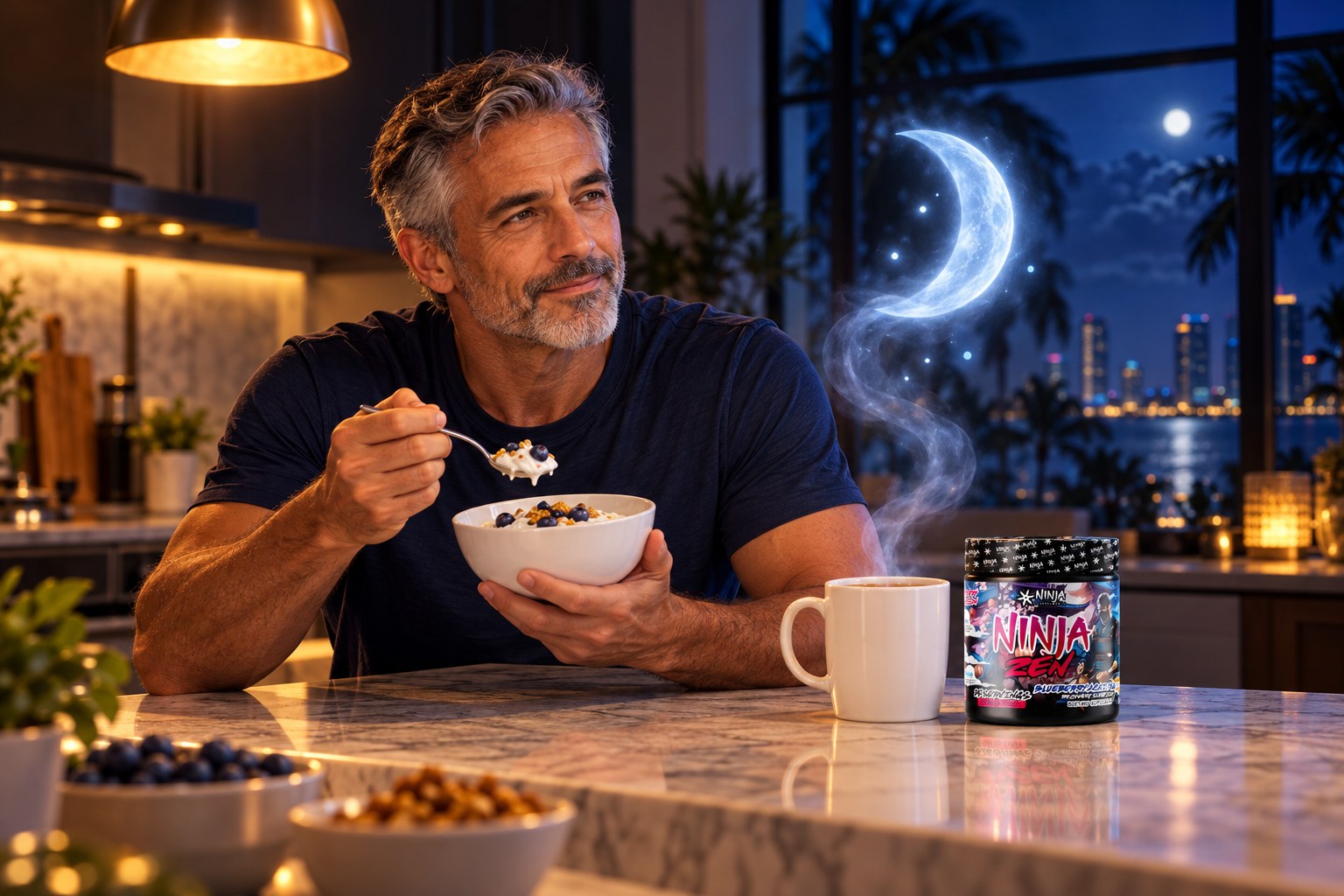
Ninja Zen will not add a gram of muscle by itself. Its job is the part of the routine that comes after the stretches: Ninja Zen is our nighttime relaxation and sleep support formula, a caffeine-free tea-flavoured drink with 350 mg of L-theanine a scoop, inside the 200 to 450 mg a day the 2026 review of 13 trials settled on, plus 2 mg of melatonin. If your training is dialled in and your nights are the leak, this is the scoop that belongs at the end of the day. The full ingredient-by-ingredient breakdown is in Which Sleep Supplements Help Muscle Recovery?
Who it’s for: lifters who train hard, run short on sleep and want a caffeine-free wind-down that supports relaxation and restful sleep. Who it’s not for: anyone about to drive, anyone pregnant or nursing, anyone under 18, and anyone on prescription medication, especially for mood or sleep, without their doctor’s yes.
Ninja Zen: The Doses This Article Is About
Per serving, straight from the label. The full label is on the product page.
| L-Theanine | 350 mg |
| Melatonin (N-acetyl-5-methoxy tryptamine) | 2 mg |
The numbers: $53.99 for 25 scoops is $2.16 a night, or $1.84 a night with Subscribe and Save (15% off). All four flavours are in stock: Blueberry Acai Tea, Honey Lemon Tea, Mango Ginger Tea and Strawberry Hibiscus Tea.
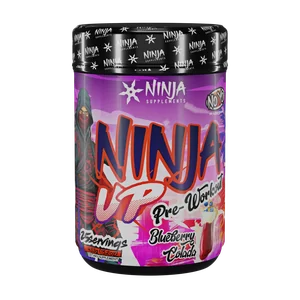
One of the products people most often buy with Ninja Zen is Ninja Up, our high-stim pre-workout, for the other end of the day: Up early, outside that 6-hour caffeine window at the very least, and Zen once the night is done.
Love it! I use it nightly to get a solid nights sleep, wake up refreshed and ready for my day.
This is beyond amazing product! Had a little trouble with my first shipment due to MY own error, but Ninja hooked it up and took care of me on the spot with a New Order! Amazing company & Amazing Service. Ninja Vanish 🥷🏼💨
Works very well for my husband and I
Zen is a full nighttime formula, so it also contains 5-HTP, L-Tryptophan and Mucuna Extract (98% L-Dopa). If you are pregnant or nursing, under 18, or take any prescription medication, especially for mood or sleep, check with your doctor before you start. Take it when your night is done, not before you drive anywhere.
Frequently Asked Questions
Is 6 hours of sleep enough to build muscle?
It falls short of the 7 or more hours a night that the American Academy of Sleep Medicine and the Sleep Research Society recommend for adults. Trials of 4 to 5.5 hours of sleep found slower muscle protein synthesis and more lean mass lost on a diet. No trial we read tested exactly 6 hours, so the safe bet is the seventh hour.
Can I go to the gym with 5 hours of sleep?
Yes. A 2018 review of 17 studies found one sleepless night had little effect on strength, though several short nights in a row could reduce force on big compound lifts. Interval training during a short-sleep week also held muscle protein synthesis at normal levels in a 2020 trial.
How much sleep do you need to build muscle?
For adults, 7 or more hours a night on a regular basis, per the American Academy of Sleep Medicine and the Sleep Research Society. They add that more than 9 hours may suit young adults and people recovering from sleep debt. The recommendation is for most nights, not one long lie-in at the weekend.
Does lack of sleep lower testosterone?
It can, quickly. In a 2021 trial of 13 healthy young adults, one night without sleep lowered testosterone by 24% and raised cortisol by 21% the next day, alongside an 18% drop in muscle protein synthesis.
Is it bad to work out right before bed?
Not usually. A 2019 meta-analysis of 23 studies found evening exercise did not harm sleep in healthy adults. The exception was vigorous exercise ending an hour or less before bedtime, which was linked to taking longer to fall asleep and less total sleep.
Next read: Does Magnesium Help You Sleep? And when the routine above is done, Ninja Zen is the last scoop of the day.
Sources
- Lamon S, et al. The effect of acute sleep deprivation on skeletal muscle protein synthesis and the hormonal environment. Physiological Reports, 2021.
- Saner NJ, et al. The effect of sleep restriction, with or without high-intensity interval exercise, on myofibrillar protein synthesis in healthy young men. The Journal of Physiology, 2020.
- Nedeltcheva AV, et al. Insufficient sleep undermines dietary efforts to reduce adiposity. Annals of Internal Medicine, 2010.
- Watson NF, et al. Recommended Amount of Sleep for a Healthy Adult: A Joint Consensus Statement of the American Academy of Sleep Medicine and Sleep Research Society. Sleep, 2015.
- Knowles OE, et al. Inadequate sleep and muscle strength: Implications for resistance training. Journal of Science and Medicine in Sport, 2018.
- Stutz J, et al. Effects of Evening Exercise on Sleep in Healthy Participants: A Systematic Review and Meta-Analysis. Sports Medicine, 2019.
- Drake C, et al. Caffeine effects on sleep taken 0, 3, or 6 hours before going to bed. Journal of Clinical Sleep Medicine, 2013.
- Jäger R, et al. International Society of Sports Nutrition Position Stand: protein and exercise. Journal of the International Society of Sports Nutrition, 2017.
- Cotter J, et al. Examining the effect of L-theanine on sleep: a systematic review of dietary supplementation trials. Nutritional Neuroscience, 2026 (authors from industry research teams).
How we wrote this: we rewrote this page around the question Google’s page one now answers for it, “does sleep affect muscle growth”, and the hour-by-hour questions people search next (5, 6, 7 and 8 hours). We read the trials, reviews and consensus statement above, checked every Ninja Zen dose against the product label, and took every price from the store on 25 October 2026. These statements have not been evaluated by the Food and Drug Administration. This product is not intended to diagnose, treat, cure, or prevent any disease.