

If you lift, aim for about 1.6 grams of protein per kilogram of body weight a day: roughly 0.7 grams per pound. That is where a 2018 meta-analysis of 49 trials and 1,863 people saw extra protein stop adding lean mass. Going up to 2.2 g per kg (about 1 g per pound) is the top figure the research reports, not a requirement, and the official 0.8 g per kg covers the needs of nearly all healthy adults, not muscle building.
Protein searches run about 64% higher in January than in December, so the New Year crowd is about to ask this question with a fresh gym membership. Here is the number, the math for your body weight, how much to eat at one sitting, and whether a scoop of protein powder belongs in the plan.
The Short Version
- The daily number: gains in lean mass from training stopped climbing beyond 1.62 g of protein per kg a day across 49 randomised trials (British Journal of Sports Medicine, 2018).
- The range the experts give: 1.4 to 2.0 g per kg a day for most people who exercise, and 2.3 to 3.1 g per kg may be needed by trained lifters holding on to muscle in a calorie deficit (ISSN position stand, 2017).
- Per meal: about 0.4 g per kg at each of at least four meals, or 20 to 40 g a serving (Journal of the International Society of Sports Nutrition, 2018; ISSN, 2017).
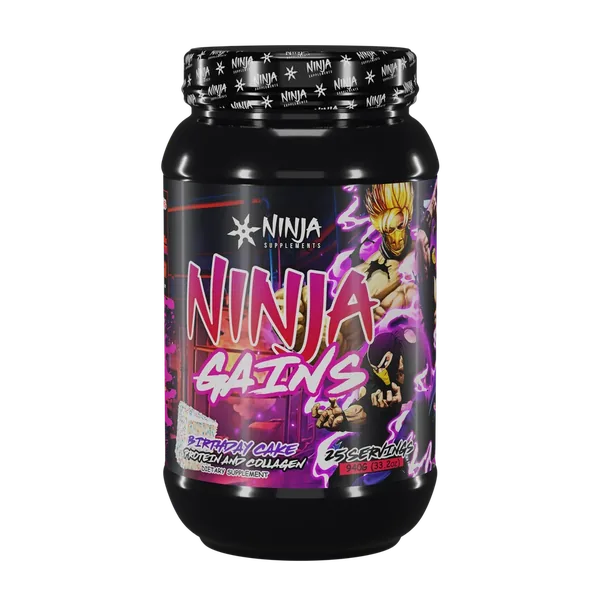
- Ninja Gains holds 31 to 33 g of protein a scoop, depending on the flavour, 21 g of it complete protein from whey protein isolate.
How Much Protein Do You Need a Day to Build Muscle?
About 1.6 g per kg of body weight a day, if you train with weights. The number comes from a 2018 meta-analysis in the British Journal of Sports Medicine that pooled 49 randomised trials and 1,863 people lifting for at least six weeks. Protein on top of training added strength and muscle, and gains in lean mass stopped beyond a total intake of 1.62 g per kg a day.
The International Society of Sports Nutrition (ISSN) lands in the same place: 1.4 to 2.0 g per kg a day is enough for most people who exercise. A 2018 review that set out guidelines for spreading protein across the day used 1.6 g per kg as the minimum to aim for and 2.2 g per kg as the upper figure reported in the research.
The number you have probably seen on a nutrition website is 0.8 g per kg: the Recommended Dietary Allowance for adults set by the National Academies. It is set to cover the needs of nearly all healthy adults. The sports numbers above come from studies of people training to build muscle, which is why they sit at double it.
Quick math: your body weight in pounds times 0.7 gives you the daily target; times 1.0 gives you the top of the range.
| Body weight | Daily target (1.6 g per kg) | Top of the range (2.2 g per kg) | Per meal, four meals (0.4 g per kg) |
|---|---|---|---|
| 150 lb (68 kg) | 109 g | 150 g | 27 g |
| 180 lb (82 kg) | 131 g | 180 g | 33 g |
| 200 lb (91 kg) | 145 g | 200 g | 36 g |
| 220 lb (100 kg) | 160 g | 220 g | 40 g |
| 250 lb (113 kg) | 181 g | 249 g | 45 g |
Two honest limits. The same meta-analysis found the extra protein helped less as people got older and more in people who already trained. And the effect was modest: about 0.3 kg of extra lean mass and 2.5 kg more on a one-rep max over the trials. Protein is the fuel. The training is still the engine.
How Much Protein Can Your Body Absorb at Once?
More than the gym myth says. The idea that your body can only use 20 to 25 g at a sitting rests on studies like a 2009 trial of six young men after leg training, where muscle building maxed out at 20 g of egg protein. Later work moved the ceiling. In 2016, 30 trained men got a bigger muscle-building response from 40 g of whey than from 20 g after a whole-body workout. A 2023 study in Cell Reports Medicine went further: 100 g of protein after exercise produced a bigger and longer response, lasting more than 12 hours, than 25 g.
So a big dinner is not wasted. The practical plan is still to split it. The 2018 review on per-meal protein concluded that about 0.4 g per kg at each of at least four meals is the way to reach 1.6 g per kg a day, and the ISSN suggests 20 to 40 g a serving every three to four hours. Think of it as the split after a Miami heist: the haul is the daily number, and four even cuts keep the whole crew happy.

Does Protein Timing Matter?
Much less than the total. A 2013 meta-analysis pooled 23 studies and 525 people on muscle growth and found that once the analysis controlled for the other factors in the studies, eating it around the workout made no significant difference to strength or size. The strongest predictor of muscle growth was total protein intake.
That does not make timing worthless. The ISSN notes that protein before or after training both work, and that the effect of a workout on muscle lasts at least 24 hours, which is why a rest day still needs its protein. Hit the daily number first, spread it out second, and stop panicking about a 30-minute window. Recovery keeps going overnight, which is why sleep matters for muscle growth too.
Should You Take Protein Powder?
Only if food is not getting you to your number. Protein powder is food in a tub, not a magic ingredient. The ISSN says it plainly: active people can get their protein from whole foods, and supplements are a practical way to get enough high-quality protein without piling on calories. For the busy lifter who comes up 30 to 40 g short most days, one scoop covers most or all of it, with no cooking.
What kind matters. Whey is a complete protein and rich in leucine, and the ISSN says fast-digesting proteins with plenty of essential amino acids and enough leucine are the most effective at switching on muscle building. Collagen is not complete: it has no tryptophan, one of the nine essential amino acids (Nutrients, 2019). In a 2020 trial in 22 older women, 30 g of whey twice a day raised muscle protein synthesis at rest and after exercise, while the same amount of collagen did less: a small rise after exercise only, and none measured over the six days. Collagen still counts toward your daily total; a 2019 analysis found up to 36% of the protein in a typical American diet could come from collagen while still meeting essential amino acid needs. Just do not count it as your muscle-building dose.
Is Too Much Protein Bad for Your Kidneys?
No harm showed up in healthy, trained men followed for a year. In a one-year crossover study, 14 resistance-trained men ate their normal diet (about 2.5 g per kg a day) and a higher protein diet (about 3.3 g per kg) for six months each. The researchers found no harmful effects on blood fats, liver function or kidney function, and no gain in fat mass despite the extra calories. The limits: 14 young, healthy men, one year. If you have a kidney condition, or your doctor has you on a special diet, your protein number comes from your doctor, not from this page.
Coach’s Corner: The Session That Spends the Protein
- Goblet squat: 3 x 8 to 12, 90 seconds rest. Hold the weight at your chest, sit down between your heels, chest up, heels down.
- Push-up (or dumbbell bench press): 3 x 8 to 12, 90 seconds rest. Body in one straight line; lower until your chest is a fist from the floor.
- One-arm dumbbell row: 3 x 10 to 12 a side, 60 seconds rest. Pull the elbow toward your hip, not your ear.
- Dumbbell Romanian deadlift: 3 x 8 to 10, 90 seconds rest. Push your hips back with soft knees, keep the dumbbells close to your legs and your back flat.
- Plank: 3 x 30 to 45 seconds, 45 seconds rest. Squeeze your glutes and keep your ribs down.
Twice a week covers the US Physical Activity Guidelines’ muscle-strengthening work for every major muscle group. When every set reaches the top of its rep range with clean form, add a little weight next session; that is how the protein gets put to work. Healthy adults: if you have an injury, pain, a heart condition, or you are new to training, check with your doctor before you start. Stop if it hurts.

The Fuel Plan
| 80 kg (176 lb) lifter | 100 kg (220 lb) lifter | |
|---|---|---|
| Daily protein, 1.6 to 2.2 g per kg | 128 to 176 g | 160 to 220 g |
| Per meal, four meals at 0.4 g per kg | 32 g | 40 g |
| Food first (USDA) | 150 g roasted chicken breast, 47 g; 150 g cooked salmon, 33 g; 3 hard-boiled eggs (150 g), 19 g; 170 g plain nonfat Greek yogurt, 16 g; 198 g (a cup) cooked lentils, 18 g | |
| A day that gets there | Breakfast: 3 eggs and the yogurt, 35 g. Lunch: the chicken, 47 g. After training: one scoop of Ninja Gains, 31 to 33 g. Dinner: the salmon, 33 g. About 147 g in all: the 80 kg lifter is covered; the 100 kg lifter adds the lentils and a bigger dinner. | |
| The scoop in your macros (label) | Ninja Gains Birthday Cake: 140 calories, 32 g protein, 3 g carbs, 1 g sugar a scoop | |
These are general numbers for healthy adults. With kidney disease, diabetes or any medical diet, ask your doctor or a registered dietitian.
Where Ninja Gains Fits
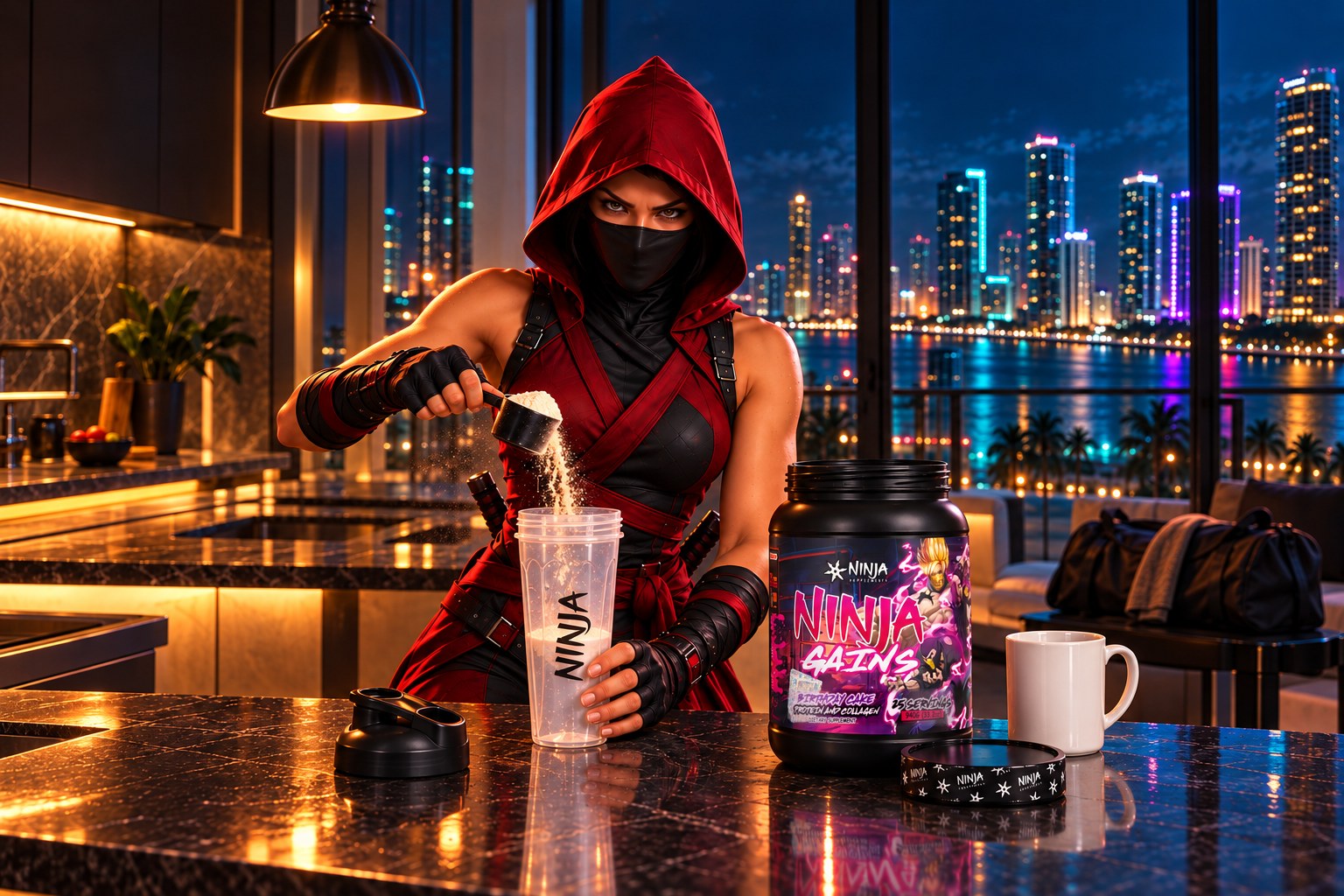
If the daily number keeps coming up one meal short, Ninja Gains closes the gap in one scoop: 31 to 33 g of protein depending on the flavour, 21 g of it complete protein from Provon 292 whey protein isolate, plus 11 g of hydrolyzed bovine collagen (types I and III). The whey alone is 21 g, past the 20 g that maxed out muscle building in the 2009 study, and the whole scoop sits inside the ISSN’s 20 to 40 g a serving. The amino acid profile printed on the label puts the whey’s leucine at about 2.1 g a scoop, inside the 0.7 to 3 g of leucine the ISSN recommends per dose. Straight talk: the whey is your muscle-building dose and the collagen is extra protein toward your daily total, well under the 36% of a day’s protein the 2019 analysis allowed for. All of it in 130 to 157 calories a scoop, depending on the flavour.
Who it’s for: lifters who come up one meal short of their protein most days and want it after training or between meals. Who it’s not for: anyone looking for a meal replacement, and anyone allergic to milk or soy (the Peanut Butter Candy flavour also contains peanuts).
Ninja Gains: The Doses This Article Is About
Per serving, straight from the label. Protein per scoop: 32 g Birthday Cake, 31 g Salted Caramel, 33 g Peanut Butter Candy. The full label is on the product page.
| Provon®292 SFL (Instantized Whey Protein Isolate 90% delivering 21g of Complete Protein) (Cross-flow) microfiltration process. Instantized with Sunflower Lecithin) | 23000 mg |
| Hydrolized Bovine Collagen (Providing Type I and III Collagen) | 11000 mg |
The numbers: $57.99 for 25 scoops is $2.32 a scoop, or $1.97 with Subscribe and Save (15% off). In stock today: Birthday Cake, Peanut Butter Candy and Salted Caramel.
The product people most often buy with Ninja Gains is Ninja Up, our high-stim pre-workout for experienced users: one scoop before the session, one after.
Best protein I've tried so far. I love the added collagen. Taste is incredible.
The best taste, best feeling for my gut & insane protein ratio. Ninja is the only protein that didn't have my gut feeling uncomfortable, the flavors are so delicious I look forward to having them each time
Best taste and macros of ALL proteins
Ninja Gains contains milk and soy, and Peanut Butter Candy also contains peanuts. If you take prescription medication, check with your doctor first.
Frequently Asked Questions
How much protein do I need a day to build muscle?
About 1.6 g per kg of body weight a day, roughly 0.7 g per pound, if you lift. In a 2018 meta-analysis of 49 trials, gains in lean mass from training stopped climbing beyond 1.62 g per kg a day. Going up to 2.2 g per kg, about 1 g per pound, is the top figure the research reports, not a requirement.
How much protein should I eat to lose weight?
If you lift and you are eating below maintenance, the ISSN says trained lifters may need more: 2.3 to 3.1 g per kg a day to hold on to lean mass in a calorie deficit, about 1 to 1.4 g per pound. Protein helps you keep the muscle; the calorie deficit is what takes the weight off.
Can you eat too much protein?
For healthy lifters, a year-long study is reassuring: 14 resistance-trained men eating about 2.5 to 3.3 g per kg a day showed no harmful effects on blood fats, liver function or kidney function. It was a small study of young, healthy men; if you have a kidney condition, your doctor sets your number.
How much protein can your body absorb at once?
There is no hard 20 to 25 g cap. After a whole-body workout in trained men, 40 g of whey raised muscle protein synthesis more than 20 g (2016), and a 2023 study found 100 g gave a bigger response lasting more than 12 hours than 25 g. Spreading about 0.4 g per kg over four meals is still the practical plan.
Is 100 grams of protein a day enough?
For a lifter who weighs about 62 kg (137 lb), yes: 100 g is 1.6 g per kg. For an 80 kg (176 lb) lifter, the 1.6 g per kg target is about 128 g, so 100 g leaves him short. Multiply your weight in pounds by 0.7 to find your own number.
Is collagen a complete protein?
No. Collagen has no tryptophan, one of the nine essential amino acids, so it is classed as an incomplete protein (Nutrients, 2019). It still counts toward your daily total, but for building muscle, whey did better: in a 2020 trial in 22 older women, whey raised muscle protein synthesis more than collagen, and only whey kept it raised over six days.
Next read: BCAA vs EAA: Which Do You Actually Need?, if you are wondering whether aminos can stand in for protein. And when the day comes up one meal short, Ninja Gains is one scoop.
Sources
- Morton RW, et al. A systematic review, meta-analysis and meta-regression of the effect of protein supplementation on resistance training-induced gains in muscle mass and strength in healthy adults. British Journal of Sports Medicine, 2018 (one author has received dairy industry funding).
- Jäger R, et al. International Society of Sports Nutrition Position Stand: protein and exercise. Journal of the International Society of Sports Nutrition, 2017.
- Schoenfeld BJ, Aragon AA. How much protein can the body use in a single meal for muscle-building? Implications for daily protein distribution. Journal of the International Society of Sports Nutrition, 2018 (one author advises a sports nutrition brand).
- Schoenfeld BJ, Aragon AA, Krieger JW. The effect of protein timing on muscle strength and hypertrophy: a meta-analysis. Journal of the International Society of Sports Nutrition, 2013.
- Moore DR, et al. Ingested protein dose response of muscle and albumin protein synthesis after resistance exercise in young men. American Journal of Clinical Nutrition, 2009.
- Macnaughton LS, et al. The response of muscle protein synthesis following whole-body resistance exercise is greater following 40 g than 20 g of ingested whey protein. Physiological Reports, 2016.
- Trommelen J, et al. The anabolic response to protein ingestion during recovery from exercise has no upper limit in magnitude and duration in vivo in humans. Cell Reports Medicine, 2023 (one author from a dairy company).
- Oikawa SY, et al. Whey protein but not collagen peptides stimulate acute and longer-term muscle protein synthesis with and without resistance exercise in healthy older women: a randomized controlled trial. American Journal of Clinical Nutrition, 2020.
- Paul C, Leser S, Oesser S. Significant Amounts of Functional Collagen Peptides Can Be Incorporated in the Diet While Maintaining Indispensable Amino Acid Balance. Nutrients, 2019 (one author from a collagen maker).
- Antonio J, et al. A High Protein Diet Has No Harmful Effects: A One-Year Crossover Study in Resistance-Trained Males. Journal of Nutrition and Metabolism, 2016.
- National Academies (Institute of Medicine). Dietary Reference Intakes for Energy, Carbohydrate, Fiber, Fat, Fatty Acids, Cholesterol, Protein, and Amino Acids. 2005.
- US Department of Health and Human Services. Physical Activity Guidelines for Americans, 2nd edition. 2018.
- US Department of Agriculture. FoodData Central (SR Legacy: roasted chicken breast, cooked farmed Atlantic salmon, hard-boiled egg, plain nonfat Greek yogurt, boiled lentils), read 28 October 2026.
How we wrote this: we wrote this page because “how much protein” is searched about 90,500 times a month in the US and “how much protein should I eat a day” another 60,500 (Google Ads Keyword Planner, September 2026), and the top question Google shows for “protein powder” is whether you should take it. We read the meta-analyses, trials and position stand above, took every food number from USDA FoodData Central, checked every Ninja Gains number against its labels, and took the price and flavours from the store on 28 October 2026. These statements have not been evaluated by the Food and Drug Administration. This product is not intended to diagnose, treat, cure, or prevent any disease.